
Monday, December 25, 2006


Saturday, December 23, 2006
More quick notes from the garden...
I planted today...
The Sweet Charlie bare-root strawberries that I planted yesterday have already put out new growth:
 Finally, on a non-gardening note: My family and I took an impulse run to Lake Woodruff Wildlife Refuge this evening on the off-chance of spying the pair of Whooping Cranes that have made the area their winter haven. We caught them just as they returned to the area, amongst a large flock of Sandhill Cranes, far off in a remote section of the refuge:
 There are, at best, a few dozen of these cranes in Florida, a few hundred in the USA.
- eighteen Broccoli di Rapa (from Pinetree): thirty days
- nine Delfino Cilantro (Pinetree)
- nine Agina Cutting Celery (Pinetree): sixty-three days
- half a window box of Reggae Raddish. Supposedly very resistant to splitting.
The Sweet Charlie bare-root strawberries that I planted yesterday have already put out new growth:
 Finally, on a non-gardening note: My family and I took an impulse run to Lake Woodruff Wildlife Refuge this evening on the off-chance of spying the pair of Whooping Cranes that have made the area their winter haven. We caught them just as they returned to the area, amongst a large flock of Sandhill Cranes, far off in a remote section of the refuge:
 There are, at best, a few dozen of these cranes in Florida, a few hundred in the USA.

Friday, December 22, 2006
Have yourself a sultry Christmas...
I spent a warm, humid and very un-December-like morning in the garden:
- planting blueberries from Johnson's Nursery, two Climax and two Misty.
- pruning back roses, especially Prosperity, which is still suffering from a bit of black spot and was pretty twiggy.
- putting some Burgmansias that I've received from friends into the ground.
- pricking out and planting some plugs of Red Sails.
- harvesting some baby carrots and turnips, more to thin the boxes than to eat, but they're not far from full-sized.
- general yard cleanup
Friday, December 15, 2006
Deluge
We had the heaviest rain in months last night. Here on the north-east side of DeLand, it rained in excess of three inches. My lettuce crop got pretty banged up, but most things seem no worse for the beating. Considering all the things I've moved or planted in the last week, the rain was a blessing.
Wednesday, December 13, 2006
Cucino cukes
 I ate the first few of these, standing in the garden after a day of yardwork. Mmmmm. I fear, though, that I managed to kill the one Cucino plant I had when I decided it was a good idea to move the plant from where it was growing on a tomato cage to my new vertical gardening frame... Hopefully not.
I wound it round the strings dangling from the new aluminum-post arbor I constructed... Pics tomorrow, if the plant survived.

Heads up!
 I planted a nine-pack of broccoli in the garden the third week of October. A couple of them simply failed to grow -- I don't know what happened, but they failed to form roots and never grew. But five of them have survived these six weeks, and they've slowly encroached on the Collards and Radishes. Pretty plants, but MUCH larger than I'd expected -- they are currently thirty inches or so in diameter.
Last week, a friend mentioned that she'd planted a mess of broc, and they'd grown all winter and spring without producing a single head.
 Sigh. With that in mind, I had planned to yank my broccoli in a couple of weeks: Too much space in my tiny plot. But yesterday I pulled apart the central set of leaves, and spied a tiny head of broccoli forming in the center....
According to my books, I'll be able to harvest the central flower, and then several subsequent lateral ones, providing several months of harvest.
I'll likely not plant broccoli again: There are too many alternative cruciferous like Broccoli Rabe that offer quicker payoff and more edible portions. I did cut a few of the largest leaves off the broccoli this week to buy some space for the collards, and ate them in a pasta dish. Tasty, and not so different from collards.

Sunday, December 10, 2006
A busy weekend...
Let's see, I did a lot this weekend:
- Planted ten Foxgloves (Foxy) and five Delphiniums, from 4" pots I bought at DeBary Nursery. I don't like buying seedlings, but both of these are a bit of a challenge to grow from seed in time for them to bloom in early spring.
- Pricked out a bunch of Poppies of unknown type from my good gardening friend Jane.
- Planted twelve peas ('Cascadia' and 'Knight'): It's been frustrating with these peas: I've planted them twice now, with only a fraction of them getting to the seedling stage. I think I'm planting them too deeply & the mulch smothers them before they can germinate. So this time I put them in six-by nursery flats in straight up vermiculite, then into a mini-greenhouse. We'll see... Should be easy to transplant.
- Picked a bunch of collards and lettuces. Red Sails continues to be outstanding in my garden.
- Cleaned up the saplings around my oak trees, laid out newspapers, and covered the area with straw and leaves. I'm going to plant the new Sasanqua camelias that I purchased from the (very much improved) 'Place in the Son' nursery. (I'll leave aside the whole nonsense of a Christian-based business... they run a good ship there and have the BEST selection of camelias and azaleas I've seen in the area.)
- Planted the two dwarf Citrus (a tangerine and a Hamlin orange).
- Planted the Flordabell Peach tree.
- Potted up some of the rooted cuttings from my greenhouse, including a really attractive Begonia I got at a plant trade.
Thursday, December 07, 2006
Favas, chard and spinach
I planted out in the garden sixteen Windsor Favas (from Pinetree). In seed starter cells, I planted Bright Lights Chard and Space Spinach. All of them from Parks Seeds.
I doubt that the Favas will produce much in the way of beans, but I love Fava shoots, and they make a good green manure for the cool season. Favas are, I think, closely related to Vetch, which is grown here as a cover crop.
I doubt that the Favas will produce much in the way of beans, but I love Fava shoots, and they make a good green manure for the cool season. Favas are, I think, closely related to Vetch, which is grown here as a cover crop.
Monday, December 04, 2006
Monday morning planting...
My traditional Monday morning moment in my garden. A couple of weeks ago I bought two green plastic window boxes (three-foot by six-inches by six-inches) on clearance at Lowes for three dollars. This morning in one of them I planted:
- French Breakfast Radish
- Tokyo Cross Turnips
- A mix of Adelaide and Little Finger Carrots
Sunday, December 03, 2006
Permaculture
I've been reading a bit more about the ECHO approach to gardening that I've been using this season, and I came across on Wikipedia (that amazing resource for the curious and vigorous of mind) the concept of Permaculture, which is an expansion of mulch gardening. The basic premises of permaculture are summed up here:
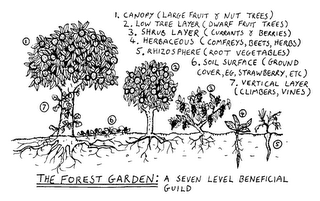
It's a wonderfully intuitive way to construct a garden — so intuitive that I was already planning to use it around the garden plot: I have a peach tree, blueberries (which get six or eight feet tall here), several dwarf citrus (on Flying Dragon rootstock, so they are no more than eight feet), Muscadine grapes that I'll trellis along the thirty-six inch fence I'm building around the garden, then pot culture of cukes and peppers (and, when things warm up, tomatoes). When the cool season's over, around the fruit trees, blueberries and grape, I'm going to try out cowpeas (ones that don't attract nematodes), and asparagus peas as a cover crop/green manure/food crop during the hot months... Hopefully I'll have a twelve-month garden.
The key to the permaculture garden is to create a thick mulch which blankets the entire garden area. This mulch can consist of many types of materials. Some materials which were listed were straw, chipped bark, stable sweepings, lawn clippings, sawdust, newspapers, cardboard, leaf mold, seaweed, cocoa beans, rice hulls, pine needles, nutshells, clothing, stones, old carpet, and roofing underfelt. Ruth Stout, one of the people using the permaculture method referred to it as the "no work garden." She considers digging soil or turning compost heaps a waste of energy and pointed out that the composting process occurs naturally throughout her garden as the thick mulch decomposes. Another advocate of the permaculture method is Masinoba Fukuoka, author of "The One Straw Revolution." He claims that the best ways to garden are found by observing nature. When gardening, he uses no digging tools and returns all plant residues back to his mulch, which he keeps at least six inches deep. He states a good mulch will "suppress weeds, return moisture, encourage earthworms, shelter beneficial microbes, and enhance tilth." Bill Mollison, a native of Australia, coined the phrase permaculture and promotes the ideals of this method. He claims that by creating a thick mulch one can start a low input sustainable garden even in places that have never been gardened before. He promotes no tillage and starts his garden plot by laying down a layer of wet newspapers and then throwing table scraps, lawn clippings, and straw on top of the newspapers to a depth of six inches. He makes sure that all the existing vegetation is covered, thereby preventing weed germination. When the mulch is in place, Mollison is ready to sow. He tears a hole in the under layered newspaper, adds a handful of ripe compost, and completes the job by planting the seed or seedling in the small mound. He states that an average size home garden only takes him forty-five minutes to mulch and plant. That also takes care of weed control for the season. At harvest time, Mollison lets the most productive and vigorous plants go to seed and uses this seed to sow next season's plantings. He claims that in consecutive years a six-inch mulch of plant residues, much of which is produced by the garden, is enough to maintain the system from year to year. He points out that creating the mulch from degradable household wastes like newspapers or old clothes is a handy and environmentally sound means of disposal and makes the system sustainable through use of materials already on site.But the concept gets made broader and more interesting yet with the approach to food growing called Forest Gardening, which extends the layering into the shrub, dwarf-tree, and fruit tree level:

It's a wonderfully intuitive way to construct a garden — so intuitive that I was already planning to use it around the garden plot: I have a peach tree, blueberries (which get six or eight feet tall here), several dwarf citrus (on Flying Dragon rootstock, so they are no more than eight feet), Muscadine grapes that I'll trellis along the thirty-six inch fence I'm building around the garden, then pot culture of cukes and peppers (and, when things warm up, tomatoes). When the cool season's over, around the fruit trees, blueberries and grape, I'm going to try out cowpeas (ones that don't attract nematodes), and asparagus peas as a cover crop/green manure/food crop during the hot months... Hopefully I'll have a twelve-month garden.
Saturday, December 02, 2006
Madame Lombard OGR
 Deeply doubled tea rose with dark green foliage. From Seminole Springs Nursery. Very vigorous.
I'm fighting a really persistent run of black spot in my garden. I usually can stop spraying this time of the year, but for whatever reason the disease is running rampant. I ended up pruning my Abraham Darby and Mr Lincoln at the beginning of November because they had been nearly defoliated. They've bounced back strongly, but of course that means I've missed out on one of the best periods for big, long-lasting blooms.
More quick pics from the garden
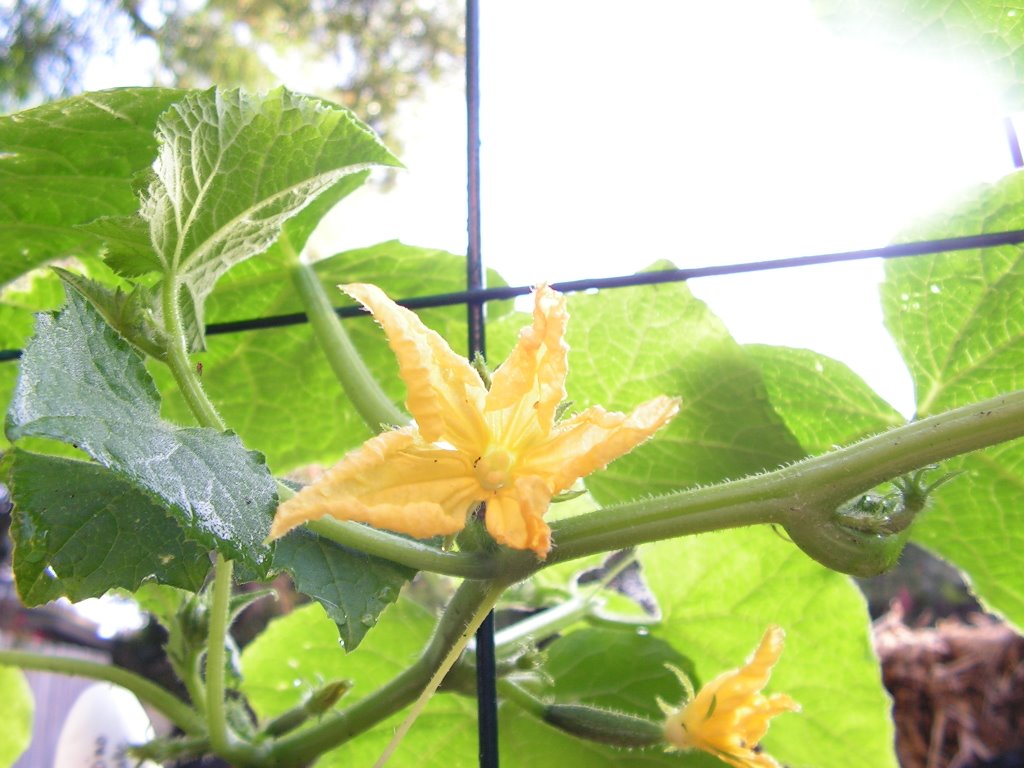 'Cucino' cukes, in bloom, planted October 14, so approximately six weeks from seed to bloom. These 'Cucino' seeds were EXPENSIVE, and only 3/4 of them sprouted. Then the frosts we had a few weeks ago took two of them down (they are apparently somewhat more susceptible than the other cucumbers I've planted, 'Salad Bush' and 'Lemon'). The fruit is forming; according to the description, it should be no larger than a cornichon.
***
My hybrid lasagna-square foot garden: using the Dryland No-Till method of preparing the bed, and the square-foot approach of intensive use of space.
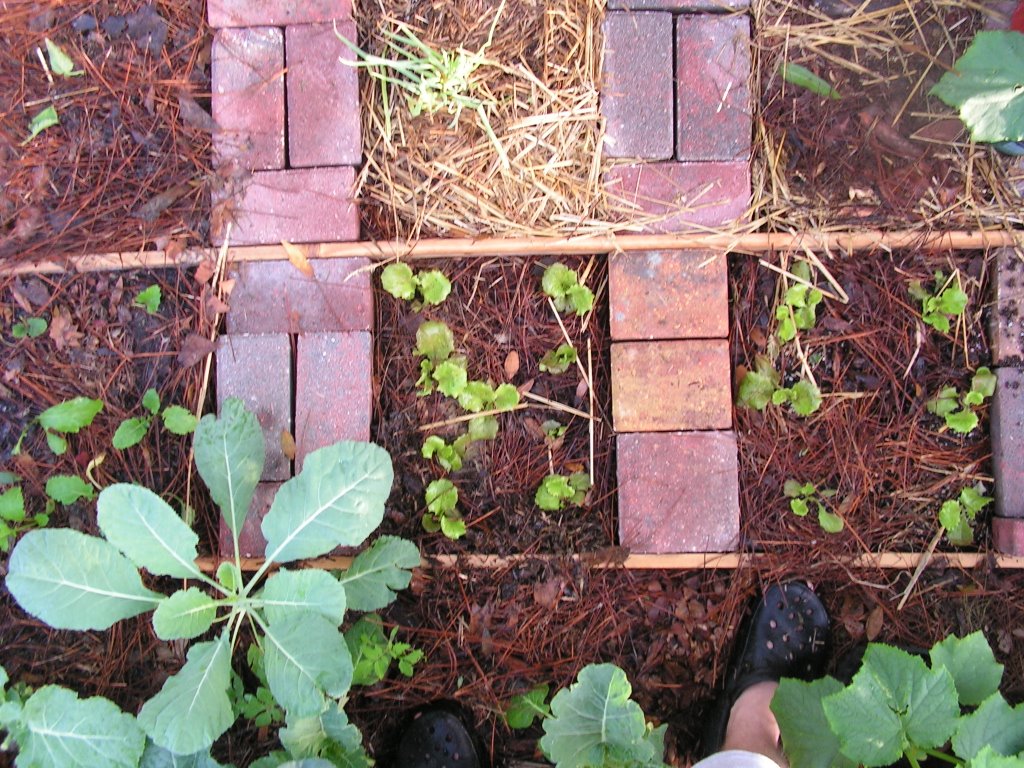 A very low-impact and low-cost way to start a garden that works well here in FLA during the cool, dry season. Every week, after I drop my daughter off at school, I spin through the neighborhood looking for bags of yard waste. A couple very thoughtful households even shred the leaves and grass clippings. I pour a bucket of water into the bag of yard waste, twist it closed, and leave it to sit for a week or two. Where I'm building the new section of the garden, I lay down a ten-sheet-deep layer of newspaper right on top of the grass (weeds and rye that I planted in October). I toss the decomposing mulch thickly over the new section of my bed. On top of that all, I lay down a cover of pine-straw for aesthetic reasons. To plant either seeds or seedlings, I pull the mulch back, tear a little gash in the newspaper, pile a half-gallon of bagged composted manure into a three-inch high hill, and in goes the seed or seedling. Then the mulch goes back around the mound, I water thoroughly, and off it grows. The roots seem to grow more out than down, finding their way through the rich compost. Again — the downside to this approach is that at least initially, the garden needs more water since the mulch drains so quickly and lies on top of the soil. Eventually I guess the mulch will become humus, and the newspapers will dissolve and maybe the water solution will be resolved.
Trying to keep things eco-friendly and cheap, I've used scavenged boards and leftover pavers to build the borders and spacers in the garden.
***

A pea ('Knight', a bushing type), pushing through the pine-straw mulch. The 'Cascadia' I planted at the same time hasn't shown itself.
***
'Florence Fennel', a bulbing fennel that I planted
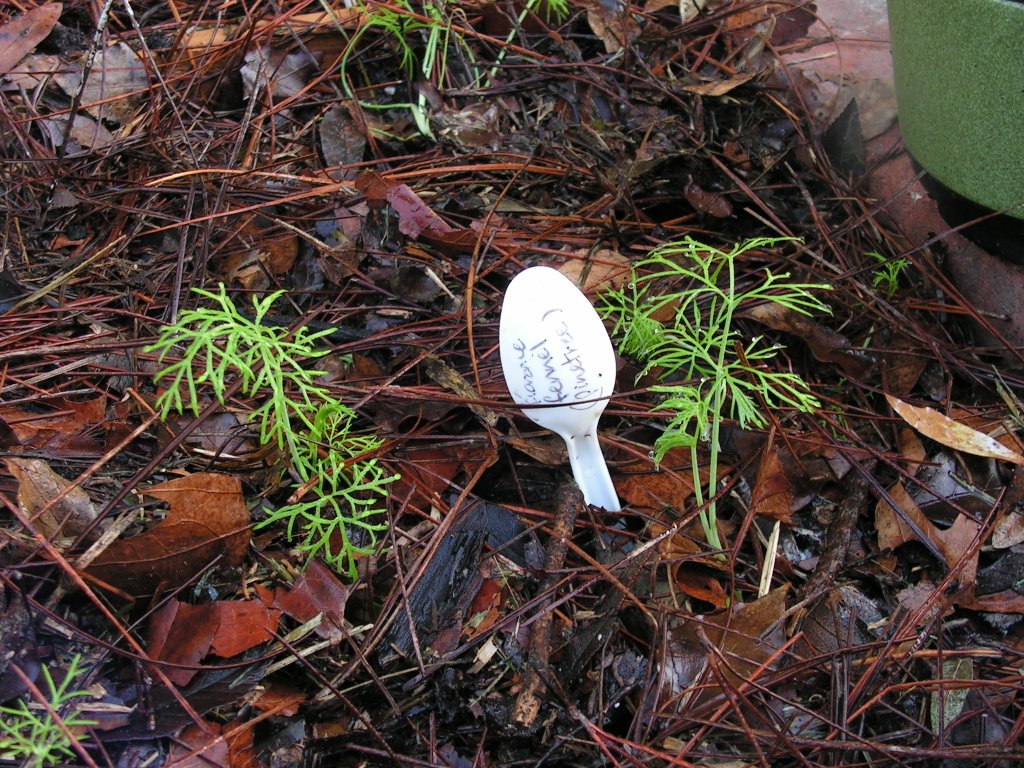 on October 23, and transplanted into the garden mid-November. I keep stepping on the tender things, but they are very forgiving.
Tuesday, November 28, 2006
Radishes!
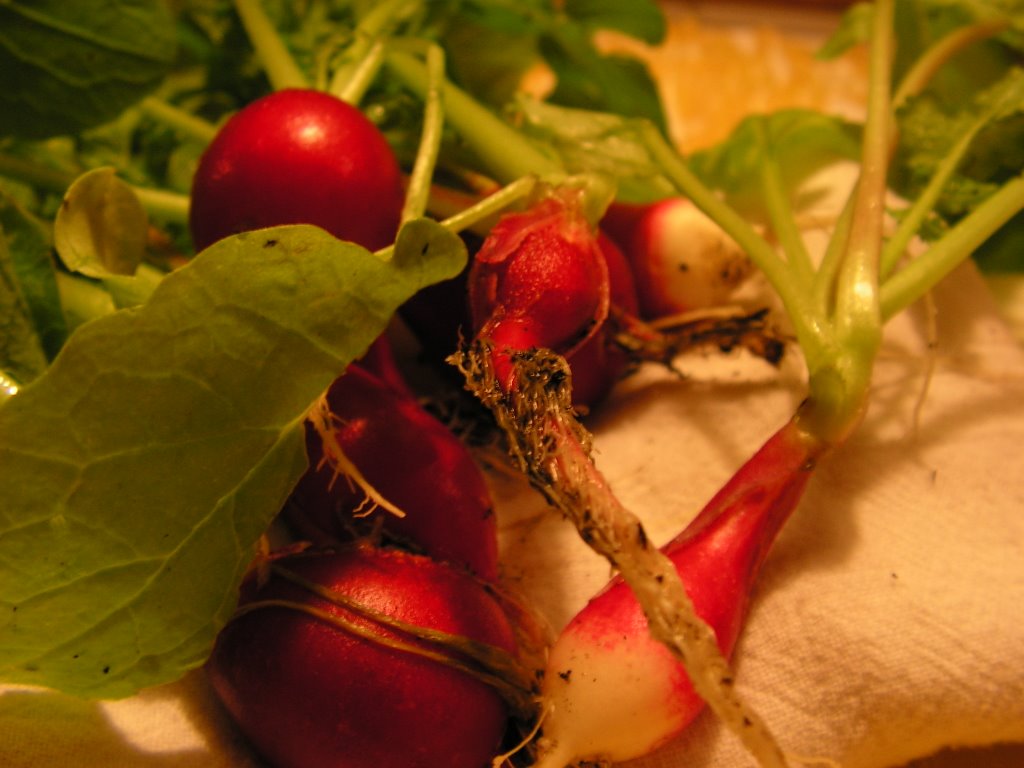 French Breakfast and Cherry Bell radishes, about thirty-four days after I planted the seeds. I grew these in an eighteen-inch by six inch window box, which was large enough to plant about twenty radishes. I've sown several other successions of radish seeds. These were very tasty, and very attractive: The French Breakfast were long, with a bright white base. We noshed them as an appetizer with freshly-baked pain au levain, Plugra butter, and Maldon salt. Mmmmmmm.....
My Just Fruits and Exotics order is ARRIVED!
From Just Fruits & Exotics, I got in the mail today...
- Brightwell (Rabbiteye Blueberry)
- Sharpblue (Southern Highbush Blueberry)
- Emerald (Rabbiteye Blueberry)
- 10 plugs of
- 1 Egyptian Walking Onion
- Muscadine Grape
- Flordabelle Peach
Everything came well packed. The strawberries were large and healthy, growing in four-inch containers. They went straight into a well-prepared mulch bed with some extra composted manure and my "home mix" organic fertilizer. I've covered them with raised screens, to keep them well shaded while they acclimate. The onions went into a square.
Everything else went back into one-gallon pots until I figure out exactly where I'm putting everything. I'd say the quality of everything was top-notch: Healthy, large and ready to grow.
I also found a moment to transplant eighteen Dukat Dill seeds and eighteen Parsley seeds from their coffee-filter birthing grounds into some small starter cells. It took eight days for the parsley to germinate, a little less for the dill. I really like this method of germinating the seeds and then transplanting them.
Monday, November 27, 2006
Another late Monday...
I work again this evening, so I stole a few moments to work in the garden. I think I've finally come to the "top" of my vegetable garden. So far, it's been a free-form affair, using the "no-till" method of newspapers and mulch I've built an ever-expanding bed for veg, herbs and some flowers in the middle of my very sunny back-yard. I've been working north and east, and now the bed is about ten feet by twenty feet, with a soft curve in the front and a butterfly garden in the middle. (I might live to regret that decision, since caterpillars make aught a difference between what they should eat and should not.) Today, I came to the north-west corner and put down newspapers, mulch: leaves, grass clippings, wheat hay, and some bagged compost. Since it's a corner, I planted some climbing peas, Tall Telephone and Super Sugar Snap (both from Pinetree). I'll use some folding tomato wire to make an l-shaped trellis for the peas to grow up. Since I planted the peas in a row along the back of the bed, I planted Radishes (French Breakfast) and carrots (Little Fingers) to fill in the square.
I really like the reasonableness of square-foot gardening: Its principles of intensive cultivation, constant rotation, and moderate quantities of vegetables synchronize well with my busy schedule. I've been using some scrap boards I found at the dump as edging, and then dividing the squares with some leftover bricks, giving me a spot to stand for seeding and picking.
It's a great time to grow here in Central Florida. Things do not grow terribly quickly, with the weak winter sun. But weeds are not a problem, and I haven't seen any bug damage to speak of. I only water every other day, if that often; however, the no-till method requires a bit more water than if I'd been able to plant in a very well-prepared, deep and friable soil. But creating such a bed here in FLA is another thing entirely...
Sunday, November 26, 2006
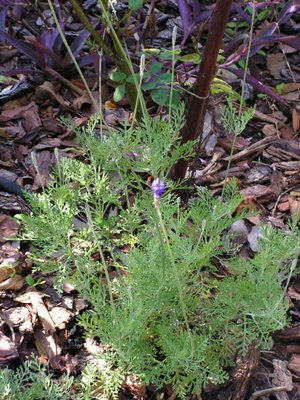
Lavandula multifida
On a Florida Forum GardenWeb recommendation, I planted this Lavandula species to replace my long-lived Indigo Spires Salvia. My hope is that it will mix it up with the La Marne pink rose (a Polyantha) that grows near the front of the bed. Lavenders by and large do not grow well in our conditions: They love the Mediterranean (or California) mix of hot sun and dry air. The sun we've got (and then some!), but most lavenders just rot in our mix of high heat and lots of moisture. I have managed to keep alive an English Lavender in a pot by keeping it in the shade, under the eves of my gazebo, where it gets hit with the sprinkler every so often. By the end of the summer, it has just a few living shoots of green, but it will recover nicely over the winter and put on a pleasing show come spring. Then I'll move it back into the shade and dry conditions and nurse it through the summer...
According to my GardenWeb sources, L. multifida thrives here. However, unlike its English cousin, I cannot say that it possesses the most beguiling of scents... The first thing that comes to mind is turpentine. That said, it's grown vigorously in the couple of months it's been in the bed. And it's a very attractive plant, with its grayish leaves and bright-blue inflorescences.
I found the following description from the excellent site of Magnolia Gardens and their very smart Plants for Texas program. We here in Central Florida have many (but not all) the same difficulties that our neighbors to the West have. I'd say what grows well there (judging by Magnolia's site) grows well here...
 Description
Lavandula multifida is not your typical Lavender that will melt in our heat and humidity. This species stands up to our wet conditions without the usual problems associated with lavenders. Fern Leaf Lavender has many deep lobed, silver coated, green leaves giving the foliage a lacy appearance and has long straight stems topped off with blue bracts usually found in clusters of 3. Lavandula multifida will grow to a height of about 24 inches and is highly aromatic making it attractive to bees. Great for use in borders, beds, and containers. Lavandula multifida is part of our Plants For Texas® Program, meaning it was Texas Grown, Tested in Texas to perform outstanding for Texas Gardens.
According to my GardenWeb sources, L. multifida thrives here. However, unlike its English cousin, I cannot say that it possesses the most beguiling of scents... The first thing that comes to mind is turpentine. That said, it's grown vigorously in the couple of months it's been in the bed. And it's a very attractive plant, with its grayish leaves and bright-blue inflorescences.
I found the following description from the excellent site of Magnolia Gardens and their very smart Plants for Texas program. We here in Central Florida have many (but not all) the same difficulties that our neighbors to the West have. I'd say what grows well there (judging by Magnolia's site) grows well here...
 Description
Lavandula multifida is not your typical Lavender that will melt in our heat and humidity. This species stands up to our wet conditions without the usual problems associated with lavenders. Fern Leaf Lavender has many deep lobed, silver coated, green leaves giving the foliage a lacy appearance and has long straight stems topped off with blue bracts usually found in clusters of 3. Lavandula multifida will grow to a height of about 24 inches and is highly aromatic making it attractive to bees. Great for use in borders, beds, and containers. Lavandula multifida is part of our Plants For Texas® Program, meaning it was Texas Grown, Tested in Texas to perform outstanding for Texas Gardens.
Some quick pics of the veg...

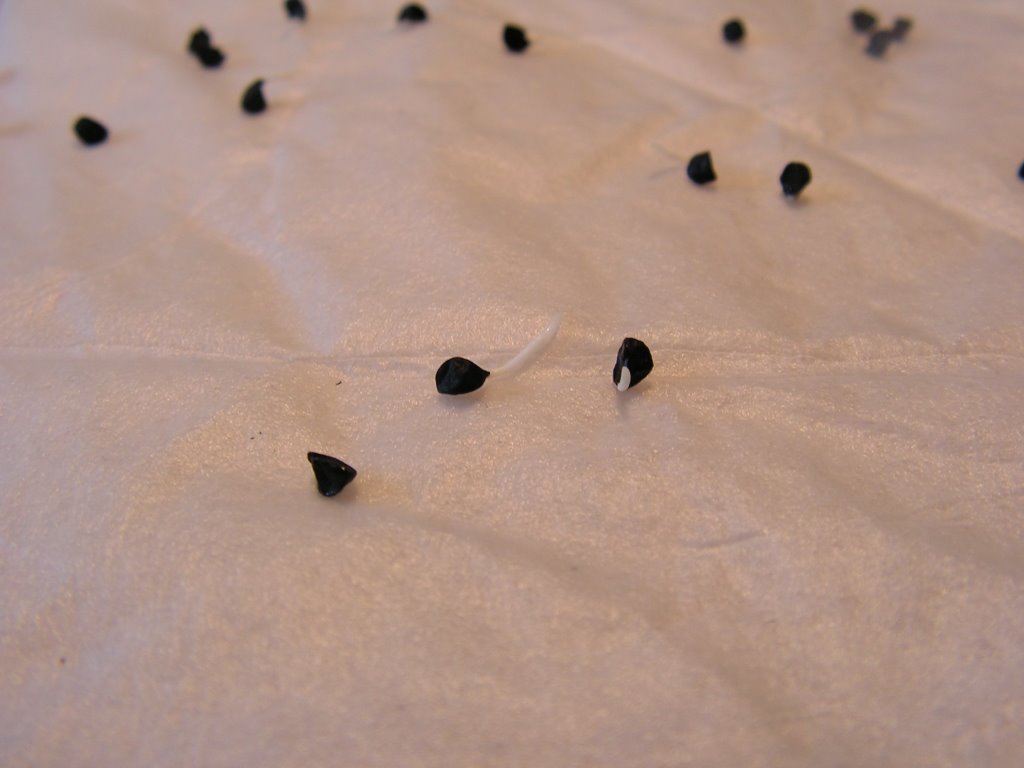
Some seeds started (the binder clips are key!)...

And radishes ready to pick
 ...
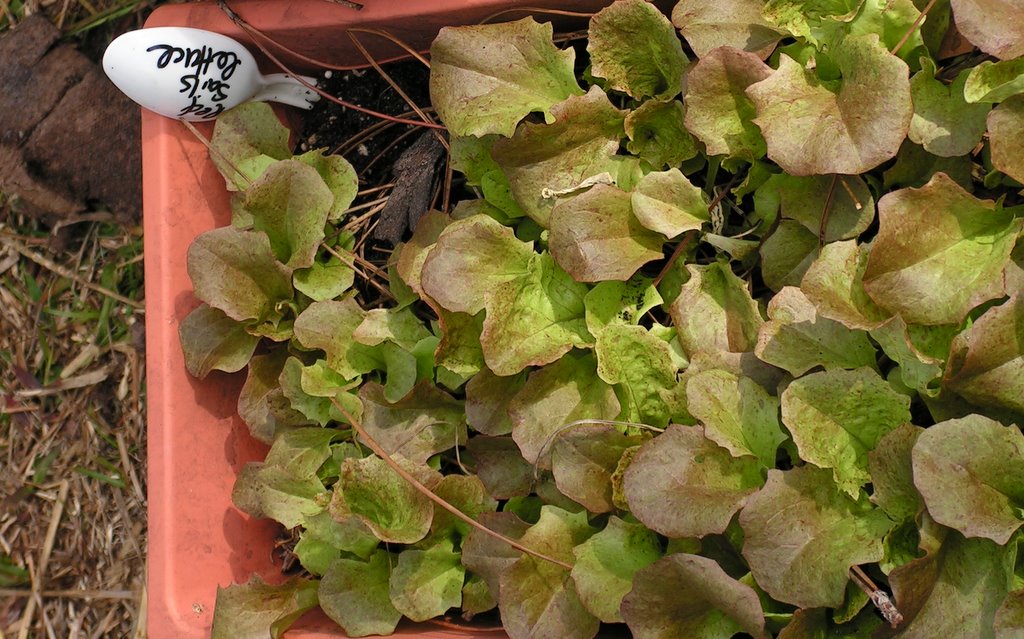
(below) Red Sails Lettuce, some to transplant into the garden, the rest to harvest as cut & come again.
(above) Mustard greens, broccoli, radishes and nasturtiums.
Cool-season veg & bloom
 With guests in town and a holiday meal to make, I didn't have much time for gardening this past weekend. I found a very few hectic minutes to plant the following on Saturday:
- In my Parks dome, I planted (1) Nigella papillosa; (2) More mixed Rocket Snaps; (3, 4) Candytuft (this only did ok for me last year, but I had a bunch of seeds and it did free-sow a bit, so why not?); (5,6) Sweet Pea 'Fantasia Mix'
- In another seed starter: Shallots 'BONILLA' from Pinetree(which I started with the "coffee filter method"); Winter Density and Red Sails lettuces (from Pinetree); Arugula 'Apollo' (from T&M).
- In a eighteen-inch by six-inch planter, mache, a varietal called BIG SEEDED from Pinetree.
It was the first "hot" weather (around 78 degrees) here for a few weeks, and a brisk wind combined to dry things out a bit in the garden. I came home from a weekend on the beach to find my poor radishes growing in boxes looking rather wilty. Speaking of the radishes, I pulled the first few: Tasty, and just a few days outside the promised thirty-day harvest (Oct. 22-Nov. 26). The bad news is that two of my cukes got too chilly (I assume) and gave up the ghost.
Subscribe to:
Posts (Atom)