Hi all, the first of the fall tomatoes just started to ripen. The winner of the race for the earliest tomato looks to be the Sweet Quartz cherry and just behind it was the Golden Gem. Had some for lunch on Sunday and they sure were good!My Jet Setter tomatoes are coming along nicely, but still green. Tonight's near-freezing temperatures may do them in... so be it.
Showing posts with label tomatoes. Show all posts
Showing posts with label tomatoes. Show all posts
Tuesday, November 18, 2008
Fall tomatoes...
Delta Charlie knows what he's talking about, and he recommended two cherry tomatoes for fall planting:


Sunday, July 27, 2008
What to do with a mess of cowpeas...
My 'Mississippi Silver' cowpeas have kicked into full production. They love all the heat and humidity you give them, but they're also very drought-hardy.
Though advertised as a bush bean (Southern Exposure Seed Exchange), they'll vine when given the chance, and produce a bit more heavily. I grow them around the border of my garden, with sticks and bamboo stakes. The trick, I think, to harvesting them is to leave them until the individual peas are clearly defined and the hulls go every so slightly yellow--the peas are still green, and they slide out of the hull without a problem.
At the end of the season, I pick the last round to dry and use next year, and mow them down as green manure.
Here's the dish I made tonight, based roughly on a recipe from Ronni Lundy's excellent southern cuisine cookbook, From Butterbeans to Blackberries:
Really satisfying and easy vegetarian cooking. But I imagine it would complement some barbecued ribs, too.
Though advertised as a bush bean (Southern Exposure Seed Exchange), they'll vine when given the chance, and produce a bit more heavily. I grow them around the border of my garden, with sticks and bamboo stakes. The trick, I think, to harvesting them is to leave them until the individual peas are clearly defined and the hulls go every so slightly yellow--the peas are still green, and they slide out of the hull without a problem.
At the end of the season, I pick the last round to dry and use next year, and mow them down as green manure.
Here's the dish I made tonight, based roughly on a recipe from Ronni Lundy's excellent southern cuisine cookbook, From Butterbeans to Blackberries:
In a large kettle, cook two cups cowpeas until tender--about five minutes in heavily salted boiling water ought to do it. If you have a couple handfuls of young cowpeas (shell and all), pole beans, or yard-long beans handy, toss them in during the last minute or two.Eat at room temperature with a big plate of cornbread and a glass of bourbon. (I'm from Kentucky...)
Scoop the beans out with a slotted spoon, and toss in a half a pound of elbow macaroni. Cook until al dente, drain, and toss with a tablespoon of olive oil. Set all of this aside to cool.
Meanwhile, chop finely one large scallion and one rib of celery. (You could also use a sweet Italian pepper here, but not a green bell pepper, which even animals won't eat...)
Roast a large green tomato over an open flame on the end of a fork (as Luny puts it, like a marshmallow over a campfire), or broil/grill it until it's softened a bit and the skin is all black. (Failing either of these, a cast iron skillet over medium heat works, too.) When the tomato has cooled, peel it, but don't worry if there's still some charred skin. Chuck it in a blender, along with 1/4 cup olive oil, 1/2 cup plain yogurt (I prefer full fat), one medium garlic clove, and a heft amount of salt (at least a two teaspoons, but you go with your own preferences). Blend at high speed until very smooth.
Mix the yogurt dressing, the scallion and celery, and elbow mac and cowpeas together in a large bowl, and combine well. Taste, and add salt and pepper as needed. If things aren't zippy enough, consider a shot of red wine vinegar.
Really satisfying and easy vegetarian cooking. But I imagine it would complement some barbecued ribs, too.
Saturday, July 19, 2008
Tomatoes and Peppers
Today, for fall/winter garden,I planted some Solanaceae:
Most of those seeds were purchased from Tomato Growers Supply. Or search this site for other sources.
I've only ever had modest luck with fall-planted tomatoes. This time, I'm going to grow only the three above (and probably the couple of Sun Gold tomatoes that have been growing since early spring -- they will continue to produce until frost, if I let them). Give them a ton of room and a strong pole.
- Nepal tomato
- Black Plum tomato
- Jetsetter tomato (these three tomatoes were recommended highly for fall planting on the Florida GardenWeb forum)
- Sweet Spot X3R Hybrid pepper
- Little Fingers eggplant
Most of those seeds were purchased from Tomato Growers Supply. Or search this site for other sources.
I've only ever had modest luck with fall-planted tomatoes. This time, I'm going to grow only the three above (and probably the couple of Sun Gold tomatoes that have been growing since early spring -- they will continue to produce until frost, if I let them). Give them a ton of room and a strong pole.
Monday, June 30, 2008
Can tomatoes be grown in Floridas heat? - Florida Gardening Forum - GardenWeb
July has been the end of tomato season for me in the past. The bugs and diseases get bad, but the main problem is that tomatoes stop setting fruit when the temperatures get much above ninety or when the lows don't get below seventy... in other words, most tomatoes stop setting fruit in July. (The exceptions are small-fruited varieties, which continue to set fruit all summer.) A recommendation from the Florida Forum...
Can tomatoes be grown in Floridas heat? - Florida Gardening Forum - GardenWeb: "Well, my second mater from this summer experiment was actually much better tasting that the first one. The Solar Set is clearly setting fruit better than the Solar Fire. I have them double-potted (7gal in 10gal) to keep the soil heat down and as you can see they are up under the canopy of a live oak tree so they are only getting six hours of direct sunlight. I didn't give them any CRF and I have not been the best at hitting them with MG, and I didn't cage them because I really didn't expect them to do as well as they have so far...."Fruit set is just one problem... Bugs, heat, drought and disease are equally flummoxing. But if I ever feel the need for August tomatoes, I might give these heat-setting tomatoes a try.
Saturday, June 14, 2008
Snack-sized tomatoes

Sun Gold (the larger of the two) and Matt's Wild Tomatoes (the latter is also known as Everglades Tomato). Matt's in particular produces pretty abundantly throughout the hot season. The downside is that it is really weedy and motile. "They" say it's the ur-tomato, the wild tomato whence all others. I have my doubts, but it sure is vigorous.
Sun Gold is pretty widely considered (by the numerous accomplished gardeners I know) to be the best small tomato to grow in Florida. The fruits can be picked slightly green for a tart, rich tomato. When allowed to go completely gold, they are sweet but balanced, with a nice acidity and strong tomato flavor that is hard to find in other grape and cherry tomatoes.
I reject the American obsession with "vine-ripened" tomatoes. I think a tomato is at its best a few days before it is completely ripe, mainly because I find very ripe tomatoes to be overwhelmingly sweet. (My dad, who was a fine gardener, used to eat his tomatoes sprinkled heavily with sugar. Blech.) I like mine with a bit of an edge, and some tooth to the flesh. What's more, you can avoid troubles like splitting if you pick the fruit when the base just slightly colors. Left on the countertop for a day or two, the fruit will be perfectly ripe and ready for noshing with oil, salt, and a sliver or two of basil or tarragon.
Sunday, June 08, 2008
Tomato Hornworm caterpillar
Manduca quinquemaculata. I noticed the damage yesterday on my Goose Creek tomato, and meant to find the bugger, but got distracted. Today it continued its rampage until I found it. Though very large (more than two inches long), these caterpillars are very hard to find, since they so closely resemble a tomato leaf. I find them by gently shaking the plant -- the hornworm "leaf" weighs so much more that it continues to bob after I stop shaking.
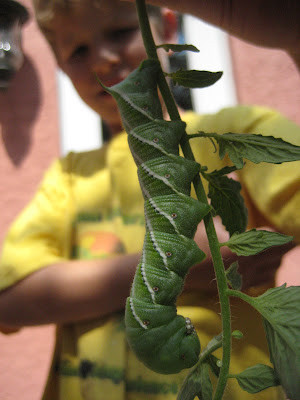
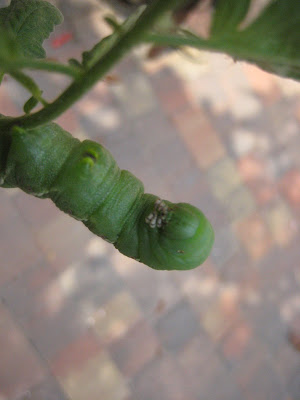
Given how quickly tomatoes grow, the damage they cause is pretty minor. I let the kids decide -- bucket of soapy water, or happy home next to the Swallowtail caterpillars. The kids gave me pollice verso and he's now contentedly munching on some tomato suckers I pulled for his delight.
Given how quickly tomatoes grow, the damage they cause is pretty minor. I let the kids decide -- bucket of soapy water, or happy home next to the Swallowtail caterpillars. The kids gave me pollice verso and he's now contentedly munching on some tomato suckers I pulled for his delight.
Thursday, March 06, 2008
Summer plantings...
Even though we're forecast to have a very cool week (highs in the 60s... in March! That's been rare the past few years...), I decided to transplant and seed some of my plants for the summer season before heading to work today.... Very briefly:
Some of my lettuce crops have bolted; they've been in the ground for months, so regardless of warm or cold temperatures, these were bound to bolt soon. I plan to replace them soon with Queensland lettuce from ECHO and more cuttings from my Okinawan Spinach.
With the exception of cowpeas and sweet potatoes, that'll be it for my summer veg garden. The cukes will be destroyed by the pickleworm by mid-May (sigh) The runner beans and tomatoes will produce into July, when they'll burn out or begin to suffer too badly from pests. I'll harvest sweet potatoes and cowpeas from mid-June until frost. I might try some yucca this summer.
- Sungold Tomato, the most prolific, tastiest tomato I grow
- Two cucumbers that I started a few weeks ago in cups, from Pinetree: BUSH CROP (55 days)
and SALAD BUSH (F1 Hybrid 56 days) - Goose Creek Tomato (thanks, Bill!)
- my "Seminole Squash" wilding from this past fall
- Rattlesnake Beans (several weeks going now)
- Cherokee Purple (from winter garden)
- Better Boy (from winter garden)
Some of my lettuce crops have bolted; they've been in the ground for months, so regardless of warm or cold temperatures, these were bound to bolt soon. I plan to replace them soon with Queensland lettuce from ECHO and more cuttings from my Okinawan Spinach.
With the exception of cowpeas and sweet potatoes, that'll be it for my summer veg garden. The cukes will be destroyed by the pickleworm by mid-May (sigh) The runner beans and tomatoes will produce into July, when they'll burn out or begin to suffer too badly from pests. I'll harvest sweet potatoes and cowpeas from mid-June until frost. I might try some yucca this summer.
Thursday, January 03, 2008
Tomato Growers Supply Order...
I'm going to grow a few more tomatoes this spring than last...
|
|
|
|
|
|
|
|
Saturday, December 29, 2007
Tomato fruitworm damage
 (photo from barbcoleus)
The damage on my 'Little Fingers' eggplants seems less severe, presumably due to its thicker skin. The damage seems to have been inflicted over a fairly short duration, since new fruits are unaffected.
Tuesday, December 25, 2007
Purple Cherokee

The first tomato of the cool/dry season. A 'Purple Cherokee' that I got as a seedling from a local sustainable grower (after Stoopid Kitty ate my seedlings and vomited them everywhere on the furniture).
I like my tomatoes a mite bit greener than perhaps most. I'll eat this one tomorrow, lightly dressed, on a plate of greens, with some chervil and parsley.
Mmmmmmmm.
Sunday, September 23, 2007
Fall seeds...

The boy & I started planting his half of the kids' garden. Our timing was off, but the boy was really excited about starting his garden, so we planted anyway and can hope for the best. We're a bit early for the 'Bright Lights' Swiss Chard and the 'Summer Glory' lettuce blend (Parks); and a bit late for the 'Miniature White' cucumbers.
For the first time, I used some shade cloth over the greens. Maybe that will allow us to sneak the plants into fall without summer's noticing. The cukes are marked forty-nine days, giving us a good chance at harvesting some before our likely frost date around the end of November.
I've been busy at work (I have to get rid of that job thing), so instead of growing my own from seed, I purchased some tomato seedlings from Nize, my friend and local organic grower. Don't get me wrong -- I was ready with a bunch started indoors. But the darn cat ate them. And the dirt they were growing in. And then vomited them everywhere. But mostly on the furniture.
Sometimes it's hard to love the cat.
Anyway, I couldn't find time to replant, and it's probably too late to start now. So, I bought some small, organic seedlings. In my own plot, I put some 'Purple Cherokee', 'Roma' and 'Better Boy' into my grow holes filled with mushroom compost.
I should quickly run down what's blooming well in my garden...
For the first time, I used some shade cloth over the greens. Maybe that will allow us to sneak the plants into fall without summer's noticing. The cukes are marked forty-nine days, giving us a good chance at harvesting some before our likely frost date around the end of November.
I've been busy at work (I have to get rid of that job thing), so instead of growing my own from seed, I purchased some tomato seedlings from Nize, my friend and local organic grower. Don't get me wrong -- I was ready with a bunch started indoors. But the darn cat ate them. And the dirt they were growing in. And then vomited them everywhere. But mostly on the furniture.
Sometimes it's hard to love the cat.
Anyway, I couldn't find time to replant, and it's probably too late to start now. So, I bought some small, organic seedlings. In my own plot, I put some 'Purple Cherokee', 'Roma' and 'Better Boy' into my grow holes filled with mushroom compost.
I should quickly run down what's blooming well in my garden...
- The zinns have started to fail. Not enough sun, so fungal issues.
- The Torenia that's been growing for months now is also looking ratty. But the cuttings I rooted still look fine, which makes me suspect a nematode problem. I'll check when I yank them.
- Confederate Rose is blooming daily.
- Roses. 'Our Lady of Guadalupe' continues to bloom nonstop. 'Tuscan Sun' is a close second. My 'Natchitoches Noisette' hasn't bloomed as much this year. It's the fourth year it's been in the ground, and it may well be starting the slow decline that is the inevitable fate of all roses not grafted on 'Fortuniana'. My English 'Abraham Darby' looks great, but I'm still waiting on 'Teasing Georgia', an English Rose I bought in the spring from the (now defunct) MerryGro Farms. It's growing well, just a little reluctant to bloom. But I think I should have a nice flush in November. It's not a great time for roses here, but fall's blooms are right around the corner.
- My geraniums made it through the summer for the first time. They look great. Keeping them pretty dry was, I think key. And so did starting them from seed. I should probably try to remember to plant some of the seeds I got from Swallowtail next week.
- Brugs rock. And so does my Datura. I need more.
Saturday, August 25, 2007
Cucumbers, tomatoes & figs
More typical late-August weather has returned to our area -- hot and humid with rain promised this afternoon. (Cross my fingers...)
I spent the morning sweating out in the garden, continuing my cleanup, getting ready for the transition to fall. I trimmed back some roses, weeded, mulched some beds. My glads are finally starting to bloom. I've been patient with the snapdragons that I planted back in December. They bloomed wonderfully all spring. Usually I pull them out and replace them with something that can take the heat and wet conditions. Since I was gone for so much of the summer, though, I decided to see whether they would make it through the summer. They did, it seems, but it wasn't pretty. They never quite stopped blooming all summer, but the display was weak. I hope they put on a display again this fall, and maybe even again in the spring.
I transplanted some cucumbers ('Bush Crop' (55 days) and 'Miniature White' (49 days), both from Pinetree) and some tomatoes ('Black Plum' and 'Jetsetter'). I continue to play around with my micro-sprinkler system. By next spring, I hope to have the whole garden under this highly-efficient, low-tech system.
My old neighbor, who has a huge fig tree planted between her sidewalk and the street, let me pick a bag of figs this afternoon. My wife makes a fabulous fig tart... My own fig has put on a burst of growth this month, and has set a bunch of figs which may or may not ripen in time to pick before the end of summer...
An update: It poured the day after I planted the tomatoes. More than an inch. Washed the little seedlings away. Oh, well, that's why you always plant more than you need.
I spent the morning sweating out in the garden, continuing my cleanup, getting ready for the transition to fall. I trimmed back some roses, weeded, mulched some beds. My glads are finally starting to bloom. I've been patient with the snapdragons that I planted back in December. They bloomed wonderfully all spring. Usually I pull them out and replace them with something that can take the heat and wet conditions. Since I was gone for so much of the summer, though, I decided to see whether they would make it through the summer. They did, it seems, but it wasn't pretty. They never quite stopped blooming all summer, but the display was weak. I hope they put on a display again this fall, and maybe even again in the spring.
I transplanted some cucumbers ('Bush Crop' (55 days) and 'Miniature White' (49 days), both from Pinetree) and some tomatoes ('Black Plum' and 'Jetsetter'). I continue to play around with my micro-sprinkler system. By next spring, I hope to have the whole garden under this highly-efficient, low-tech system.
My old neighbor, who has a huge fig tree planted between her sidewalk and the street, let me pick a bag of figs this afternoon. My wife makes a fabulous fig tart... My own fig has put on a burst of growth this month, and has set a bunch of figs which may or may not ripen in time to pick before the end of summer...
An update: It poured the day after I planted the tomatoes. More than an inch. Washed the little seedlings away. Oh, well, that's why you always plant more than you need.
Saturday, August 04, 2007
Fall 2007 tomatoes...

I started, in paper cups with plastic cup liners, the following tomatoes for my fall crop:
- Nepal
(OP) 80 days
A high quality, intensely flavored, meaty, deep red 12-ounce beefsteak. This Himalayan heirloom produces well even under cool growing conditions. Indeterminate vines.
- Black Plum
(OP) 70 days
Tall indeterminate vines produce sweet, deep mahogany morsels perfect for backyard grazing. No other tomato quite like it--we are pleased to offer this rare and very special variety.
- Jetsetter
64 days. Lycopersicon esculentum. (F1) Plant produces good yields of very flavorful 8 oz tomatoes. Tomatoes turn red when mature and have a very rich tomato taste. This variety matures very early offering those in the South a great early harvest. Excellent in salads or sandwiches. Disease Resistant: VFFNTA. Indeterminate.These varietals were recommended on GardenWeb. The 'Nepal' and 'Black Plum' seeds are from Swallowtail, the Jetsetter I got off of eBay.
I have also started various Torenia from seed (they germinated very quickly -- maybe five days, though the seed packet warns of slow germination) & a bunch of sunflowers for my daughter's flower garden.
Saturday, July 21, 2007
The end of (full sized) tomatoes...
I couldn't deal with the stinkbug invasion, and decided to call it quits with my two remaining full-sized tomatoes. I'd planted these using the modified post--hole method, and they've been providing us with plenty of tomatoes since March. Absolutely no signs of RKN.
I plan to start tomatoes the middle of next month, for transplant into the garden the middle of September. For my fall crop, I'm going to try: Black Plum, Jetsetter, and maybe Nepal. All recommendations from the Florida Forum on GardenWeb.
I plan to start tomatoes the middle of next month, for transplant into the garden the middle of September. For my fall crop, I'm going to try: Black Plum, Jetsetter, and maybe Nepal. All recommendations from the Florida Forum on GardenWeb.
Wednesday, July 18, 2007
Papalo salsa
OK, I've been won over. I really liked this salsa cruda, my translation of this recipe. It was an excellent way to use up some green tomatoes, and had a nice complexity.
We served this salsa mounded in fried masa boats, sprinkled with goat cheese and, piled high on top, fresh garden cress and purple basil from the garden. It was a great summer dish!SALSA AL PAPALOQUELITE
Under a broiler or on a hot, dry skillet, roast four garlic cloves (in their jackets) and two to four cuaresmeños chilies (cuaresmeños peppers are a kind of large jalapeños -- I used two of my very hot Italian Roasting Peppers, from TGS). The garlic skin should just color on all sides before removing; the peppers should be nicely browned and blistered all over. When cool, peel the peppers and remove the veins and seeds. (Now, go wash your hands, and don't touch ANYONE for at least a few hours!) Peel the garlic.
Chuck the peppers and garlic in a blender or food processor, along with six leaves of papalo, half a pound of hard green tomatoes, the juice from half a small lemon, a splash of olive oil, and salt to taste (about 2 tsp). Whiz it until just smooth. Taste for salt and acid. Right before serving, add some thin slivers of white onion (or scallion whites) that you've rinsed in plenty of cold water.
Sunday, May 27, 2007
Tomatoes
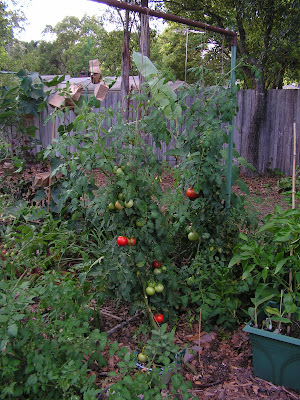
(tomatoes on the trellis -- matt's wild on the left, tiffany in the middle, better boy in the background
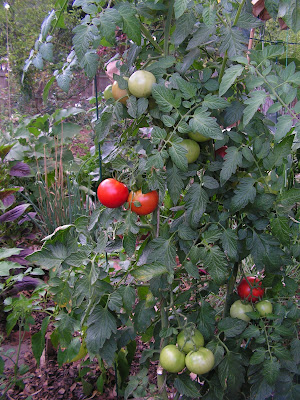
(tiffany, with thirty-eight walnut-sized or larger tomatoes and another dozen or so smaller. i've already harvested no fewer than a dozen. it's a VFNT hybrid, so no disease problems. pretty good flavor, great texture, good keeping. nice to have smaller tomatoes (3-4 oz). they look exactly like those "tomatoes on the vine" from the grocery store, growing in clusters of 4-5 fruits. from TGS.)
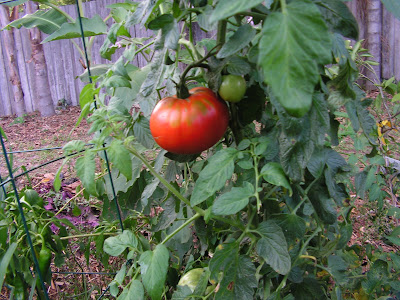
better boy. i've harvested several tomatoes that weighed in at more than a pound. delish. but in the end, the tiffany produces more tomatoes and the size is better suited for eating.
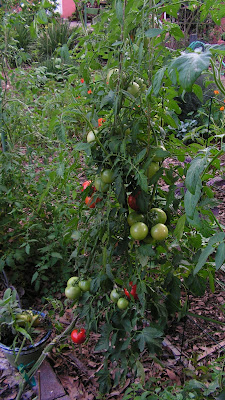
another shot of tiffany, from the other side, so you can see how many tomatoes are on one vine. the whole bush must weigh 30#, and i've had to add a bunch of strings to keep it up. they didn't break during the heavy winds this week.
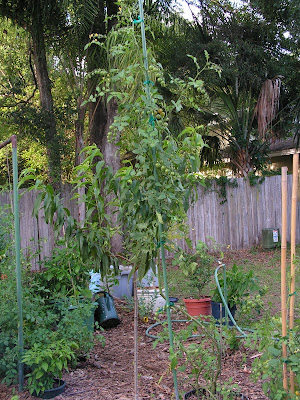
i don't know if you can see this: but in the middle of the photo, a sun gold, growing in a large pot, that has hit the 9 foot limit of the conduit i'm using as a pole. i've decided to pull all the leaves from the bottom 1/3 of the plant and make it into a tree. my garden is a mess.
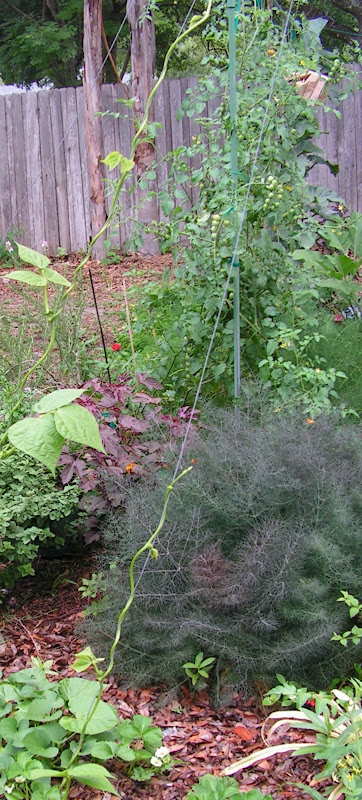
'yellow currant' (TGS). not a very good pic, but what a tomato! it's already at 10', much better behaved than matt's (it grows upright and the stems are self-supporting with a very little bit of help), more prolific than sungold, and the tomatoes are pretty good. if you look carefully, you can see the scads of tomatoes that grow in clusters of about 20 1/2" tomatoes.
anyway -- the in-ground tomatoes are all planted using the posthole method (thanks, delta charlie!), with one slight improvement: i dig out all the crappy sand in a narrow (maybe 18" diameter) hole, enough to fill a 5-gallon bucket. the sand gets dumped in a low spot in my yard. i use three or four paper grocery sacks, stacked together to form a very thick, stiff bag, to line the hole: i fold the top edge down a few times, enough to form an even stiffer cuff around the top of the bag, so the bag remains open and is about 2' tall. then, i stuff the bag into the hole i've dug, leaving the cuff a bit above the surface. i fill the hole with straight-up compost from my kitchen-scrap heap. i usually add a handful of water-retention crystals (i nursery friend gave me a ton of them for free), and then i test the ph and adjust with sulfur. (for whatever reason, my compost is a bit sweeter than tomatoes like it.) (oh, and without complicating things too much here, the tiffany was not planted using the paper bag method, but instead using two large nursery pots with their bottoms cut out and then tied together with twine through the drainage holes, forming a cylinder about 2' long. it was way too much work, very awkward to install, and led me to the paperbag method.)
the cuff lets me do two things -- i fill it with mulch and it allows me to water more easily (just fill the cuff with water and let it seep in). it also keeps the bad soil out.
anyway, the paper bag just makes the posthole method a bit easier, since you don't have to worry about the sand collapsing back into the hole. it also keeps the nematodes out, though for how long, i don't know. every week or so, i add a couple handfuls of compost to the top of the bag to fertilize the tomatoes and keep the soil level constant.
i haven't dug one of the tomatoes out yet, but presumably the roots of the tomatoes will eventually make it through the paper bag. the plants seem pretty low in their watering needs.
oh, the trellises i've used are made from leftover chainlink fence posts. it was a lot of work, but is VERY sturdy (i did a pullup on it, and i weigh about 200 pounds!). the lighter one in the front of my bed is made from conduit -- $15 total cost in parts and it took me less than 15 minutes to install, since the conduit is stiff and narrow enough to push by hand through the sand to a depth of five feet. the elbows were more expensive than the 10' conduit lengths.
ok, i've goofed off enough here. now's time to goof off in the garden!
an update: i take back what i said about the paper-bag method's superiority over the nursery pots. when i cleaned up the garden at the end of the season, the bags had completely disintegrated, and much of the organic material in the hole had dissolved into the surrounding sands. but the nursery pots were still full of humus. so, though they are more difficult to install, i will definitely convert all my tomato holes into nursery-pot holes.
Wednesday, May 23, 2007
And the winner is...
I wanted to quickly note the State of Tomatoes in my garden. On January 6, I planted three full-sized tomatoes:
-Tiffany (a VNFT hybrid from TGS)
-Better Boy (a VFN hybrid)
-Matina (from TGS)
Tiffany produced early (end of April) and prolifically. Smallish (4 oz), perfectly round, smooth (no shoulders). OK flavor, very good texture. Fair number of seeds. They look just like those "tomatoes on the vine" you get from the supermarket. Somewhat subjectively, I'd say these hang around on the vine for a long time while ripe without suffering for the delay. Good yield, and it's nice to have smallish tomatoes.
Matina has been very disappointing. Nice tomatoes, but they actually ripened later than Tiffany (I bought them because they're supposed to be very early), and the yield has been low.
Better Boy produced a large crop, a week or so later than Tiffany. Fewer in number than Tiffany, though the yield seems roughly the same in weight. Beautiful, flavorful, dense flesh, low in seeds. I weighed one today at exactly 16 oz. It deserves all the praise it gets. I'd like to sniff and say "well, it doesn't have the flavor of a Brandywine..." or some such, but let's face it: Perfectly ripe, homegrown tomatoes all taste really really good. Subtle differences in flavor shouldn't overshadow more important criteria. It makes sense to me to choose varietals that are prolific and disease resistant. Beyond that lies only snobbery parading as discernment.
-Tiffany (a VNFT hybrid from TGS)
-Better Boy (a VFN hybrid)
-Matina (from TGS)
Tiffany produced early (end of April) and prolifically. Smallish (4 oz), perfectly round, smooth (no shoulders). OK flavor, very good texture. Fair number of seeds. They look just like those "tomatoes on the vine" you get from the supermarket. Somewhat subjectively, I'd say these hang around on the vine for a long time while ripe without suffering for the delay. Good yield, and it's nice to have smallish tomatoes.
Matina has been very disappointing. Nice tomatoes, but they actually ripened later than Tiffany (I bought them because they're supposed to be very early), and the yield has been low.
Better Boy produced a large crop, a week or so later than Tiffany. Fewer in number than Tiffany, though the yield seems roughly the same in weight. Beautiful, flavorful, dense flesh, low in seeds. I weighed one today at exactly 16 oz. It deserves all the praise it gets. I'd like to sniff and say "well, it doesn't have the flavor of a Brandywine..." or some such, but let's face it: Perfectly ripe, homegrown tomatoes all taste really really good. Subtle differences in flavor shouldn't overshadow more important criteria. It makes sense to me to choose varietals that are prolific and disease resistant. Beyond that lies only snobbery parading as discernment.
Monday, May 07, 2007
Sweet potatoes, runner beans, tomatoes...
The layout of my cold-season strawberry bed: A rough circle that gets about 8 hours a day of hot sun. I dug the strawberries into the bed, and laid down another thick layer of oak leaves and grass clippings.
My son & I started the rattlesnake beans a couple of weeks ago : I'm running wire from stakes along the perimeter to a 10' high conduit pole in the center of the bed. In theory, they'll scramble up the wires, but not shade out the white sweet potatoes (planted on Sunday) that are planted in the center of the bed or the Sungold tomato that's training up the pole. The way the sun tracks, the left (north) side of the bed should still get tons of sun, even with the beans growing up the right (south) side. The bed's very heavily mulched with hay, leaves and pinestraw. I have some pentas and milkweed mixed in there, too, since this used to be my butterfly bed.
Intensive gardening!
My son & I started the rattlesnake beans a couple of weeks ago : I'm running wire from stakes along the perimeter to a 10' high conduit pole in the center of the bed. In theory, they'll scramble up the wires, but not shade out the white sweet potatoes (planted on Sunday) that are planted in the center of the bed or the Sungold tomato that's training up the pole. The way the sun tracks, the left (north) side of the bed should still get tons of sun, even with the beans growing up the right (south) side. The bed's very heavily mulched with hay, leaves and pinestraw. I have some pentas and milkweed mixed in there, too, since this used to be my butterfly bed.
Intensive gardening!

Tuesday, May 01, 2007
May Day Veg

I don't know what varietal these cukes are -- I bought them at Lowes. That's one plant that has been trellised onto four strings to keep them off the ground and less prone to fungal problems. I've harvest dozens of cukes so far. I ended up making some tasty quick pickles with the excess. If you look carefully, you can see the next couple of dozen cukes ripening on the vine.

These are Tiffany tomatoes from TGS. Very vigorous, early to set fruit and redden, nice yield so far with probably two dozen medium-sized fruit now ripening. They are VFNT, so if they taste decent, I'll definitely raise them again next year.

Yellow Banana Peppers. Good yield, tasty.

Quail Grass, an Amaranth (like Celosia) that's supposed to be very mild and low in oxalic acid and nitrates, making them tastier and easier to digest than must tropical greens. I tried some raw a few days ago and found it to taste pretty much exactly like spinach, only less oxalic acid (the unpleasant bitterness/grittiness that characterizes spinach past its prime) and a bit nuttier. Tasty.
I had some trouble with germination and slugs, but two plants survived and that's all that can likely fit in the four-square feet I've given them. It gets five feet tall and blooms in the fall.
Pretty plant, no?
I had some trouble with germination and slugs, but two plants survived and that's all that can likely fit in the four-square feet I've given them. It gets five feet tall and blooms in the fall.
Pretty plant, no?
Wednesday, April 25, 2007
Spring's bounty

A bouquet I picked for my secretary for 'National Secretary's Day', along with some cucumbers from the garden. The flowers are a mix of Alstroemeria, roses, snapdragons and whatever filler caught my eye. I included a gardenia for aroma... That one bloom filled the office with that tropical, heady, sultry smell of gardenias...

These are 'Cucino' cukes, an F1 hybrid that produces loads of finger-length cukes with thin skins and a dense, satisfyingly-melon interior. My kids love them. Oh, and some 'Yellow Currant' tomatoes. These have proved to be wildly and wonderfully vigorous. There are several hundred tomatoes already on a single plant. I'd call them more reddish than yellow, but they have a nice, typical balance of sweet and acid.
Subscribe to:
Posts (Atom)