Wunder Blog : Weather Underground:
Lake Okeechobee Update
After the recent rains from Tropical Storm Fay, Lake Okeechobee has responded quite nicely. Based upon the latest information provided by the SFWMD (South Florida Water Management District), the average lake level now stands at 12.52 feet. To put this into perspective, in the past three days, a little over 40% of the deficit has been erased.
With all the rainfall still ongoing north of the lake and the constant rain bands swirling in from the southern side, Okeechobee will likely continue to rise and will likely be above the 13 foot mark by Sunday for the first time in nearly 21 months (if my memory serves me right here). If the lake were to reach or exceed the 13 foot mark, the lake would only be about a foot below normal.
All in all, while Tropical Storm Fay has become a nuisance for all Florida, it has served as a blessing in disguise. For the past four years, all Florida has been mired in a severe water shortage crisis that has resulted in water restrictions throughout the state. (Yes, there are still water restrictions in place in South Florida.) With this significant rainfall received by Tropical Storm Fay, it will replenish most the depleted water supply and will fill Lake Okeechobee to near normal levels. In addition, this will also help hold off the salt-water intrusion"
Showing posts with label sustainable living. Show all posts
Showing posts with label sustainable living. Show all posts
Friday, August 22, 2008
Lake Okeechobeee
This news is very, very good. It won't solve our water problems for the long term, but it does reset conditions back to normal. Since 2004, our droughty conditions have only made our man-made mess worse.


Wednesday, August 06, 2008
Supermarket Chains Narrow Their Sights
The trend deepens and broadens...
Shorten. The. Supply. Chain.
Supermarket Chains Narrow Their Sights - NYTimes.com: "Some independently owned, small-to-medium-size chains have been selling extensive lines of local seasonal fruits and vegetables for years, lines they are now expanding.Since the advent of modern grocery, retailers have dreamed of getting rid of produce altogether. Veg and fruit present all sorts of difficulties from a perspective of efficiency and cheapness, and what's more, the markup was minimal if not a net loss for the store. A shift in perspective on the part of the consumer could, perhaps, change all that. Local food has a cache and character that industrial food lacks. That added value, combined with higher transportation costs forcing retailers to source locally, might do communities a world of good. I might be accused of mercantilism or autarky, but our mantra, for everything from energy to broccoli, should be:
For the largest supermarket chains, though, where for decades produce has meant truckloads transported primarily from the West Coast, it’s not always easy to switch to the farmer down the road.
But soaring transportation costs, not to mention the cachet customers attach to local food, have made it more attractive not just to supermarkets but to the agribusiness companies that supply them.
Growers like Dole and Nunes have contracted with farmers in the East to grow products like broccoli and leafy greens that they used to ship from the West Coast. Because of fuel costs, in some instances the cost of freight is more than the cost of the products."
[...]
Hannaford Brothers, with 165 stores in New York, Vermont, New Hampshire, Maine and Massachusetts, has always sold local produce, but in the last two years its customers have pushed it to offer more. “There’s been a 20 percent increase in sales” in the last year, said Michael Norton, a company spokesman. “Our research tells us consumers have about five or six reasons for wanting local: freshness and taste; keeping farmland in the community and having open spaces; a desire to be close to the food source and know where it comes from; support of local farmers and keeping money in the community. Embedded in all of this is concern about food safety. All this creates pretty powerful interest.”
Shorten. The. Supply. Chain.
Saturday, July 19, 2008
Anarchy!
Path to Freedom:
"Since the early 80's the Dervaes family has slowly transformed their ordinary city lot into a self sufficient urban homestead.
View an eco-pioneers life on an urban homestead as this family shares their homegrown revolution, being the change they wish to see by living the solution."
Monday, June 30, 2008
Envisioning a world of $200-a-barrel oil - Los Angeles Times
Envisioning a world of $200-a-barrel oil - Los Angeles Times.
Not so long ago, it was just dirty frickin' hippies and know-nothing Kentucky farmers who were preaching "shorten the supply chain."
Not so long ago, it was just dirty frickin' hippies and know-nothing Kentucky farmers who were preaching "shorten the supply chain."
"Local distribution patterns could change too. Stephen Gaddis, chief executive of Pacific Cheese Co., a Hayward, Calif., cheese processing and packaging firm, thinks high fuel prices will push restaurants, retailers and food manufacturers to look for suppliers closer to their operations.
'Local sourcing is ideal. You won't pay as much for freight, and when you use less fuel it's better for the environment,' Gaddis said.
Soaring diesel prices will make companies rethink whether they should have large, centralized plants or build smaller ones around the country.
That's what Pacific Cheese is doing. It's building a packaging plant in Texas to be closer to one of its larger suppliers and expects to serve its Southwestern clients from there.
In the near future, however, consumers can expect to pay for the higher cost of producing food and moving it around the country, say food executives, farmers and economists. Even having a deep-dish pizza with extra cheese brought to your door costs more now that chains such as Pizza Hut are charging for delivery."
Wednesday, June 18, 2008
Yes, We Will Have No Bananas!
Having lived in Russia during the early 1990s, when bananas were a novel rarity that merited standing in line for hours, I enjoyed this article and its focus on the strange ubiquity of bananas in the United States. The article doesn't mention the parthenocarpy (sterility) of the (cultivated) banana, which makes it very difficult to breed new cultivars that are resistant to a given disease.
Op-Ed Contributor - Yes, We Will Have No Bananas - Op-Ed - NYTimes.com: "Americans eat as many bananas as apples and oranges combined, which is especially amazing when you consider that not so long ago, bananas were virtually unknown here. They became a staple only after the men who in the late 19th century founded the United Fruit Company (today’s Chiquita) figured out how to get bananas to American tables quickly — by clearing rainforest in Latin America, building railroads and communication networks and inventing refrigeration techniques to control ripening...The final piece of the banana pricing equation is genetics. Unlike apple and orange growers, banana importers sell only a single variety of their fruit, the Cavendish. There are more than 1,000 varieties of bananas — most of them in Africa and Asia — but except for an occasional exotic, the Cavendish is the only banana we see in our markets. It is the only kind that is shipped and eaten everywhere from Beijing to Berlin, Moscow to Minneapolis.I guess I never knew that we ate Cavendish. It kind of bums me out, since I have a huge Cavendish with tons of fruit ripening out in my garden now. I agree that Cavendish is less tasty than other kinds of bananas I've tried. I have a NOID banana growing on the side of my house that every year and a half produces forty or fifty pounds of really tasty, custardy, half-size bananas.
That bananas have long been the cheapest fruit at the grocery store is astonishing. They’re grown thousands of miles away, they must be transported in cooled containers and even then they survive no more than two weeks after they’re cut off the tree. Apples, in contrast, are typically grown within a few hundred miles of the store and keep for months in a basket out in the garage. Yet apples traditionally have cost at least twice as much per pound as bananas.Well, let's leave aside the obvious geographism here, in the Deep South, where we're far closer to banana growing conditions than to apple land. (Ignoring, for the moment, the tropical apples growing in my grove.) $150 a barrel oil will surely change the way we eat as much as it changes the way we commute.
Tuesday, June 17, 2008
Queering the front yard...
I spent a long, hot Saturday helping my friend Mark transform his front yard into an edible landscape. We have something like a labor cooperative -- everyone shows up for a few hours on a weekend, and pitches in on a project. Company makes the drudgery into a pleasure.
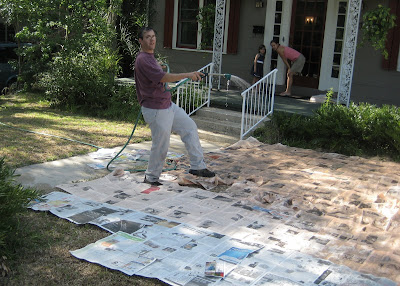
We had some help from Tony, who started it off with a few layers of newspaper to defeat the St. Augustine. Tony minces. The girls have no idea what to make of it.
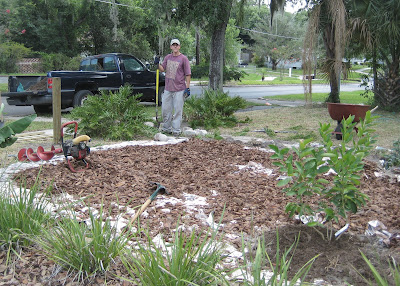
Then a thick layer of pine bark nuggets in the sunniest part of the yard, for a small fruit grove.
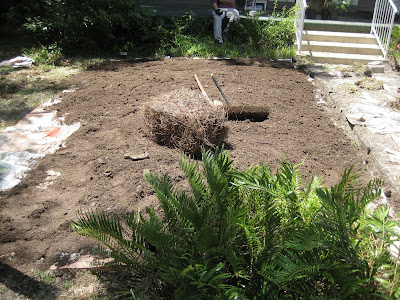
On the east side of the yard, which gets just a bit less harsh Florida afternoon sun, we put a yard of mushroom compost.
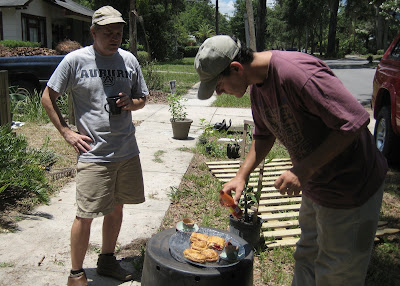
A civilized break. Guava pastries, espresso, and lots of cold beer.
We also put up a fence to give the yard some structure. In the grove, we planted Persian Lime, Meyer Lemon, Red Dragonfruit, and a Dwarf Cavendish banana... oh, and some dwarf, weeping mulberries.
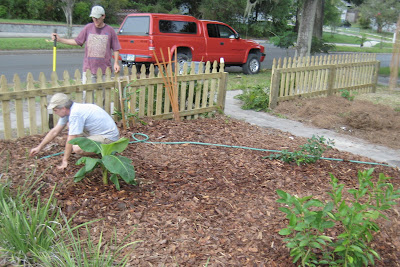
Mark loves Caribbean cuisine, so we put in my idea of an island summer garden: Sweet potatoes, lots of hot peppers (Tabasco, Habanero), Sun Gold tomato, some Okinawan Spinach (not very Caribbean, of course, but we needed some greens!), basil, oregano and cassava. It'll take a few weeks to fill in, but with all the sun and water, things will be overgrown by mid-July.
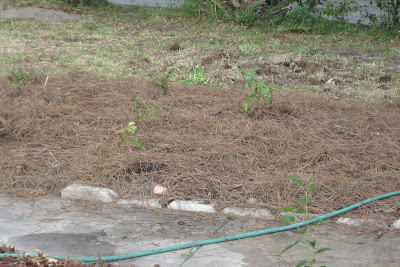
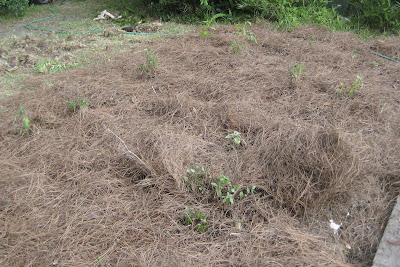
I'm most excited by the Dragonfruit, which I've never grown myself. We got it at Edible Nursery in Daytona, which has a pretty good selection of fruits for our zone.
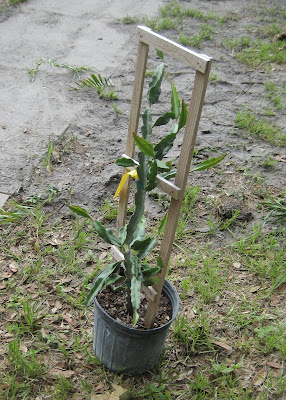
Since Mark's property is on a hill, the fence took a lot of time to get right. The three of us spent about eight sweaty hours digging holes, cutting posts, spreading mulch and compost, and cleaning up.
This is just the beginning. Mark's yard get a LOT of sun, with west and south exposure. There's a perfect spot for a big avocado tree, and plenty of space for a bit more citrus, a peach tree or two, and maybe a tropical apple or two. We need to add okra and crowder peas to his summer garden.
Mark was inspired at least in part by an article by Michael Pollan in the "Green Issue" of the New York Times Magazine a few weeks ago. Faced with the seemingly overwhelming challenges, and frankly the apocalyptic possibilities, of global climate change, Pollan asks "Why bother?" When the problems are so big, can individual action really make a difference? Isn't it like feeling guilty for the flood downstream because you pissed in the river? Pollan makes a great argument, one that derives much of its worth from something Wendell Berry said about four decades ago in a book I dearly love (and one of the reasons I garden now):
Pollan claims that we should bother, we must do something, that our individual choices and stances can ramify through culture -- he cites the example of Vaclev Havel and Adam Michnik, who decided during the deep funk of communism in Eastern Europe, to just act as if they were free. Their personal example "created a tiny space of liberty that, in time, expanded to take in, and then help take down, the whole of the Eastern bloc." It's a bit of an overstatement, but there's truth in it.
We had some help from Tony, who started it off with a few layers of newspaper to defeat the St. Augustine. Tony minces. The girls have no idea what to make of it.
Then a thick layer of pine bark nuggets in the sunniest part of the yard, for a small fruit grove.
On the east side of the yard, which gets just a bit less harsh Florida afternoon sun, we put a yard of mushroom compost.
A civilized break. Guava pastries, espresso, and lots of cold beer.
We also put up a fence to give the yard some structure. In the grove, we planted Persian Lime, Meyer Lemon, Red Dragonfruit, and a Dwarf Cavendish banana... oh, and some dwarf, weeping mulberries.
Mark loves Caribbean cuisine, so we put in my idea of an island summer garden: Sweet potatoes, lots of hot peppers (Tabasco, Habanero), Sun Gold tomato, some Okinawan Spinach (not very Caribbean, of course, but we needed some greens!), basil, oregano and cassava. It'll take a few weeks to fill in, but with all the sun and water, things will be overgrown by mid-July.
I'm most excited by the Dragonfruit, which I've never grown myself. We got it at Edible Nursery in Daytona, which has a pretty good selection of fruits for our zone.
Since Mark's property is on a hill, the fence took a lot of time to get right. The three of us spent about eight sweaty hours digging holes, cutting posts, spreading mulch and compost, and cleaning up.
This is just the beginning. Mark's yard get a LOT of sun, with west and south exposure. There's a perfect spot for a big avocado tree, and plenty of space for a bit more citrus, a peach tree or two, and maybe a tropical apple or two. We need to add okra and crowder peas to his summer garden.
Mark was inspired at least in part by an article by Michael Pollan in the "Green Issue" of the New York Times Magazine a few weeks ago. Faced with the seemingly overwhelming challenges, and frankly the apocalyptic possibilities, of global climate change, Pollan asks "Why bother?" When the problems are so big, can individual action really make a difference? Isn't it like feeling guilty for the flood downstream because you pissed in the river? Pollan makes a great argument, one that derives much of its worth from something Wendell Berry said about four decades ago in a book I dearly love (and one of the reasons I garden now):
And they have seen that these public absurdities are, and can be, no more than the aggregate result of private absurdities; the corruption of community has its source in the corruption of character. ... Once our personal connection to what is wrong becomes clear, then we have to choose: we can go on as before, recognizing our dishonesty and living with it the best we can, or we can begin the effort to change the way we think and live.There is something so sensible, so logical -- but at the same time, so humane and patient in the way that Berry writes. We must "begin the effort to change."
Pollan claims that we should bother, we must do something, that our individual choices and stances can ramify through culture -- he cites the example of Vaclev Havel and Adam Michnik, who decided during the deep funk of communism in Eastern Europe, to just act as if they were free. Their personal example "created a tiny space of liberty that, in time, expanded to take in, and then help take down, the whole of the Eastern bloc." It's a bit of an overstatement, but there's truth in it.
But the act I want to talk about is growing some — even just a little — of your own food. Rip out your lawn, if you have one, and if you don’t — if you live in a high-rise, or have a yard shrouded in shade — look into getting a plot in a community garden. Measured against the Problem We Face, planting a garden sounds pretty benign, I know, but in fact it’s one of the most powerful things an individual can do — to reduce your carbon footprint, sure, but more important, to reduce your sense of dependence and dividedness: to change the cheap-energy mind.We must "begin the effort to change" somewhere, and where better than in our own front yards?
Monday, June 09, 2008
End of Exurbia
In the long run, this change is for the better.
When I moved to my present house almost six years ago, I drew a small circle around my workplace that represented a walkable distance, something I decided arbitrarily was ten minutes or so. This priority was paramount -- and I made it when gas was a couple dollars a gallon. I can walk to work, Publix is less than a mile up the road, and there are a dozen restaurants (some of them even acceptable) within a walk from my house. But I also deal with living on a busy noisy street, in a very old house, on a small plot. All decisions have opportunity costs.
My money could have gone much further had I been willing to live outside my "urban" zone, but I counted other things as more important.
"At $4 per gallon gas, $125 per barrel oil and $10 per million Btu natural gas, a lot of activity becomes uneconomical,'' says Mark Zandi, chief economist at Moody's Economy.com in West Chester, Pennsylvania.Though this blog is mostly about gardening, I wander into related issues of sustainability, community, public planning, and the economy as a whole from time to time. Times are tough for people who made bad choices, like buying cars that guzzled, and houses that were too large and too far to be practical. They were egged on by interested entities in the greater economy, told by advertisers and developers and friends that they deserved everything for nothing. But the consumers share a major part of the blame for their own bad decisions. We'll all pay the price in the long run.
The lifestyle of the exurban commuter may be one casualty.
Emerging suburbs and exurbs -- commuter towns that lie beyond cities and their traditional suburbs -- grew about 15 percent from 2000 to 2006, nearly three times as fast as the U.S. population, as Americans moved further out in search of more affordable houses or the bigger ones that are sometimes derided as McMansions.
``It was drive until you qualify'' for a mortgage, says Robert Lang, director of the Metropolitan Institute at Virginia Tech in Alexandria, Virginia. ``You can't do that anymore. Your cost of transportation will spike too much.''"
When I moved to my present house almost six years ago, I drew a small circle around my workplace that represented a walkable distance, something I decided arbitrarily was ten minutes or so. This priority was paramount -- and I made it when gas was a couple dollars a gallon. I can walk to work, Publix is less than a mile up the road, and there are a dozen restaurants (some of them even acceptable) within a walk from my house. But I also deal with living on a busy noisy street, in a very old house, on a small plot. All decisions have opportunity costs.
My money could have gone much further had I been willing to live outside my "urban" zone, but I counted other things as more important.
Thursday, April 24, 2008
Lunar Light
I live in downtown DeLand, on a busy street with streetlights, it seems, every few feet (two on my small property zone alone). I've never understood why we have so many lights, generally speaking: Walking at night along a dark beach or a quiet road, I'm always struck by how little artificial light is really necessary to navigate and feel safe, especially when it's clear. My son is into stargazing, and a month or so ago we spent a new-moon night at Woodruff Preserve stargazing with the local high school astronomy teacher. It was as dark as one could imagine, but we had no navigating the alligator-infested, boggy area.
I have also noticed how street lamps, while illuminating their narrow radius, cast deep shadows at the periphery. It seems to me that outdoor lighting, which makes our eyes so less sensitive to ambient light at night, makes areas more dangerous: The perfect place to hide for a thug would be the wells of darkness beside houses and overgrown lots, taking advantage of our purblindness.
Give me full darkness any night.
Anyway, this entry's not technically on gardening, but it's Earth Day, and I often dwell here on the intertwined issues of sustainability, localism, and the need to appreciate the beauty of the world around us. Click through to read about a civil engineering idea that would change outdoor lighting for the better: "What if streetlights could respond to ambient moonlight, dimming and brightening each month as the moon cycles through its phases?...." But what was most striking was this (unsubstantiated but unsurprising) assertion:
I have also noticed how street lamps, while illuminating their narrow radius, cast deep shadows at the periphery. It seems to me that outdoor lighting, which makes our eyes so less sensitive to ambient light at night, makes areas more dangerous: The perfect place to hide for a thug would be the wells of darkness beside houses and overgrown lots, taking advantage of our purblindness.
Give me full darkness any night.
Anyway, this entry's not technically on gardening, but it's Earth Day, and I often dwell here on the intertwined issues of sustainability, localism, and the need to appreciate the beauty of the world around us. Click through to read about a civil engineering idea that would change outdoor lighting for the better: "What if streetlights could respond to ambient moonlight, dimming and brightening each month as the moon cycles through its phases?...." But what was most striking was this (unsubstantiated but unsurprising) assertion:
Lunar Light: Perhaps the most fascinating fact that the collective’s research revealed, however, is a little-known detail about the history of electricity: in the 1930s, with the spread of electrification and the consolidation of utilities, streetlights became a convenient way to off-load excess energy from the grid at night, when power demands dropped significantly. This intentionally inefficient system determined the norm for nighttime outdoor lighting levels, a standard that has not been revised since, even though the need for off-loading ended in the 1970s. What we now assume is a safety measure is in fact the forgotten remnant of an obsolete energy practice. Next Gen juror Fred Dust, head of IDEO’s Smart Space design practice, says the jury found this part of the proposal both shocking and compelling. “It’s such an archaic concept that it seems like science fiction,” he says.
Questioning current lighting standards and asking what level of illumination is actually necessary brings some surprising answers. Willis explains that the human eye, with its com-plementary systems of rods and cones, evolved to adapt to both full-sun days and moonless nights. “We can see an incredibly broad range of intensities,” he says. “The difference between sunlight and starlight is something like a hundred thousand orders of magnitude.” Bright moonlight is in"
Tuesday, April 22, 2008
Blueberries in Florida

On impulse, a friend and I stopped by a u-pick blueberry farm outside Ocklawaha. Five bucks a pound for some delicious berries. It took, maybe, five minutes to pick three pounds. My wife made an absolutely amazing pie.
It's hard not to love Florida in April.
It's hard not to love Florida in April.
Saturday, March 29, 2008
Cuba's agricultural revolution an example to the world
Cuba's agricultural revolution an example to the world:
Laura Enriquez, a sociologist at the University of California-Berkeley, who has written extensively on the subject of Latin American agriculture, said: 'What happened in Cuba was remarkable. It was remarkable that they decided to prioritize food production. Other countries in the region took the neo-liberal option and exported 'what they were good at' and imported food. The Cubans went for food security and part of that was prioritizing small farmers.'Labor would be a simple problem to solve -- people watch a little less of the idiot box, got off their duffs, and spent some time outside. That labor would likely go a ways in improving our god awful health problems.
Cuba is filled with more than 7,000 urban allotments, or organoponicos, which fill perhaps as many as 81,000 acres. They have been established on tiny plots of land in the center of tower-block estates or between the crumbling colonial homes that fill Havana. One afternoon I visited a small garden of tomatoes and spinach that had been dug just a few hundred yards from the Plaza de la Revolution, a vast concrete square where Castro and his senior regime members annually oversee Cuba's May Day parade. More than 200 gardens in Havana supply its citizens with more than 90 percent of their fruit and vegetables.
...But could Cuba's labor-intensive example be repeated without the availability of large numbers of enforced workers?
"I don't know. I think it is true that it has required much labor," Pretty said. "The thing is that it has also produced a lot of food. ... People are also closer to their food production. (In the West) we are worried that we don't know about where our food comes from. In Havana, people are closer to their food production and that may also have psychological benefits."
Thursday, March 13, 2008
Backyards, Beware: An Orchard Wants Your Spot - New York Times
Backyards, Beware: An Orchard Wants Your Spot - New York Times:
In the last few years, an increasing number of Americans have turned their yards over to such mini orchards, planting them with dwarf and semi-dwarf fruit trees, even in dense urban areas. Suppliers around the country have seen significant increases in fruit tree sales, like the 12 to 15 percent annual sales growth reported by the Dave Wilson Nursery in Hickman, Calif., which has one of the country’s largest selection of fruit trees (more than 1,300 varieties). [...]
The backyard orchard makes sense, given the growing popularity of the local-food movement. Nothing is more local than the backyard, after all, and home orcharding, as the practice is sometimes called, guarantees freshness and cuts the energy costs for transportation to nil. Anxieties about food safety — sparked by events like last year’s E. coli outbreak in spinach — may also be contributing to the trend. Ed Laivo, the Dave Wilson Nusery’s sales director, is a longtime advocate of dense tree planting, and wrote a how-to pamphlet called “Backyard Orchard Culture” in the early 1990s. He advises customers to choose varieties that will ripen at different times to spread out the harvest, a strategy increasingly being adopted by those wanting to eat fresh. “People are planting so that they have apples for four or five months straight,” he said, “rather than having one tree dump on them in September and then have to quickly make their pies and sauces.”
Monday, January 07, 2008
"Behind the Seeds Tour" at Epcot
With in-laws in town, we spent the a warm day at Epcot. I took the "Behind the Seeds" tour, a tour of the "Living with the Land Boat Ride."
It's Disney's little "how green are we" show ride; I'm not sure I bought the line that Disney is in any way a green enterprise, or that its research will help feed the world. (On $5 a day, African villagers are supposed to buy hydroponic equipment? My support goes to ECHO, which tries to encourage global sustainability and feed the masses through ultra-low-tech methods.)
Let's face it, most of Florida is an environmental wasteland, and at the center of it sits the tens of thousands of acres around the theme parks south of Orlando. (OK, OK, the center is Big Sugar and the sweet corn industry... The parks are just the inner ring.) What's more, I sat through a thirty minute show on global energy sources (hosted by Ellen Degeneres!) that was revolting for its carefully calibrated discussion of global warming and alternative sources of energy. It was like a kindergarten teacher's graduation day address, only instead of five-year-olds, it was gas and oil conglomerates who each had "something special to contribute." Oh, and global warming is a "hot topic"... hah. But at least it didn't hedge on whether dinosaurs are God's way of testing my faith...
I try hard to ignore the waste and gluttonous consumption that Disney represents, because the kids really enjoy it. It's hard for me not to sound like an old man (I'm not!) or a grouch when I talk about Disney and the parks.
Anyway, about the "Behind the Seeds" tour. More for the hoi polloi than the dedicated gardener. Fair enough. The discussion of Integrated Pest Management was mostly about how cute ladybugs are. And I'm not convinced that hydroponic growing is an improvement over old-fashioned dirt and compost. It certainly is cooler. But the demonstration garden had some really impressive vertical gardening involved, and the tropical gardens were very interesting.
Here's a short slide show of what caught my eye. Better yet, watch it on my Picasa account.
It's Disney's little "how green are we" show ride; I'm not sure I bought the line that Disney is in any way a green enterprise, or that its research will help feed the world. (On $5 a day, African villagers are supposed to buy hydroponic equipment? My support goes to ECHO, which tries to encourage global sustainability and feed the masses through ultra-low-tech methods.)
Let's face it, most of Florida is an environmental wasteland, and at the center of it sits the tens of thousands of acres around the theme parks south of Orlando. (OK, OK, the center is Big Sugar and the sweet corn industry... The parks are just the inner ring.) What's more, I sat through a thirty minute show on global energy sources (hosted by Ellen Degeneres!) that was revolting for its carefully calibrated discussion of global warming and alternative sources of energy. It was like a kindergarten teacher's graduation day address, only instead of five-year-olds, it was gas and oil conglomerates who each had "something special to contribute." Oh, and global warming is a "hot topic"... hah. But at least it didn't hedge on whether dinosaurs are God's way of testing my faith...
I try hard to ignore the waste and gluttonous consumption that Disney represents, because the kids really enjoy it. It's hard for me not to sound like an old man (I'm not!) or a grouch when I talk about Disney and the parks.
Anyway, about the "Behind the Seeds" tour. More for the hoi polloi than the dedicated gardener. Fair enough. The discussion of Integrated Pest Management was mostly about how cute ladybugs are. And I'm not convinced that hydroponic growing is an improvement over old-fashioned dirt and compost. It certainly is cooler. But the demonstration garden had some really impressive vertical gardening involved, and the tropical gardens were very interesting.
Here's a short slide show of what caught my eye. Better yet, watch it on my Picasa account.
Wednesday, August 29, 2007
Trying to Connect the Dinner Plate to Climate Change - New York Times
Trying to Connect the Dinner Plate to Climate Change - New York Times: "The biggest animal rights groups do not always overlap in their missions, but now they have coalesced around a message that eating meat is worse for the environment than driving. They and smaller groups have started advertising campaigns that try to equate vegetarianism with curbing greenhouse gases.
Some backlash against this position is inevitable, the groups acknowledge, but they do have scientific ammunition. In late November, the United Nations Food and Agriculture Organization issued a report stating that the livestock business generates more greenhouse gas emissions than all forms of transportation combined.
When that report came out, People for the Ethical Treatment of Animals and other groups expected their environmental counterparts to immediately hop on the “Go Veggie!” bandwagon, but that did not happen. “Environmentalists are still pointing their fingers at Hummers and S.U.V.’s when they should be pointing at the dinner plate,” said Matt A. Prescott, manager of vegan campaigns for PETA."
Some backlash against this position is inevitable, the groups acknowledge, but they do have scientific ammunition. In late November, the United Nations Food and Agriculture Organization issued a report stating that the livestock business generates more greenhouse gas emissions than all forms of transportation combined.
When that report came out, People for the Ethical Treatment of Animals and other groups expected their environmental counterparts to immediately hop on the “Go Veggie!” bandwagon, but that did not happen. “Environmentalists are still pointing their fingers at Hummers and S.U.V.’s when they should be pointing at the dinner plate,” said Matt A. Prescott, manager of vegan campaigns for PETA."
Saturday, July 28, 2007
Walk Score - How walkable is your house?
Walk Score - How walkable is your house?:
"Walk Score helps people find walkable places to live. Walk Score calculates the walkability of an address by locating nearby stores, restaurants, schools, parks, etc."
An interesting site. We're in "downtown" DeLand, right across from Stetson University. We scored 60 out of 100 -- neither here nor there. Many of the entries are inaccurate (like listing a Japanese restaurant as a clothing store...), but all tools have their inadequacies, and results are only as good as data.
Subjectively, I'd rate our neighborhood as quite walkable, particularly for Florida, or generally the southeast. Many students here do without cars, and I've had short-term colleagues live here without a car.
What's your score, Floridians?
"Walk Score helps people find walkable places to live. Walk Score calculates the walkability of an address by locating nearby stores, restaurants, schools, parks, etc."
An interesting site. We're in "downtown" DeLand, right across from Stetson University. We scored 60 out of 100 -- neither here nor there. Many of the entries are inaccurate (like listing a Japanese restaurant as a clothing store...), but all tools have their inadequacies, and results are only as good as data.
Subjectively, I'd rate our neighborhood as quite walkable, particularly for Florida, or generally the southeast. Many students here do without cars, and I've had short-term colleagues live here without a car.
What's your score, Floridians?
Sunday, May 13, 2007
Local food culture...
I'm reading Bill McKibben's new book, Deep Economy. I haven't been terribly impressed so far -- Michael Pollan and Wendell Berry are far more eloquent and sophisticated in their analysis and criticisms of modern farming-food culture, but McKibben understands better the unsustainability of the whole of modern American economy.
Berry says somewhere that it's a sign of how far removed we've become from the most primal experiences of life when children know where babies come from, but not potatoes.
"Eating is an agricultural act."
I spend a fair amount of time in the garden with my children, talking about how things grow and reproduce and die. And trying to share with them the wonder and awe I have for all things living, even the writhing mass of maggots in my compost bucket. They're usually out there with me planting seeds or helping harvest cukes and tomatoes. My daughter loves to pick snapdragons and make them ROAR!
From this morning's Times:
Berry says somewhere that it's a sign of how far removed we've become from the most primal experiences of life when children know where babies come from, but not potatoes.
"Eating is an agricultural act."
I spend a fair amount of time in the garden with my children, talking about how things grow and reproduce and die. And trying to share with them the wonder and awe I have for all things living, even the writhing mass of maggots in my compost bucket. They're usually out there with me planting seeds or helping harvest cukes and tomatoes. My daughter loves to pick snapdragons and make them ROAR!
From this morning's Times:
Local Food 101, With a School as His Lab BLOOMFIELD
TALL, bald and of robust appetite, the chef Timothy Cipriano is casting an appreciative eye at the young free-range chickens clucking in their moveable, open-air run outside the Agriscience and Technology Center at Bloomfield High School. “By fall, I can give you three dozen eggs a week,” predicts Joseph Rodrigues, the agriscience teacher who oversees greenhouses, raised-bed gardens and a set of big, burbling aquaculture tanks.
“Fantastic. We’ll do frittatas,” Mr. Cipriano murmurs.
The two men are amiable and enthusiastic co-conspirators. Mr. Cipriano, the food service director for the Bloomfield school district, is also a committed activist for the Connecticut Farm-to-School program, which advocates serving students fresh, locally grown and sustainable food. He is clearly delighted by Mr. Rodrigues’s next promise: “We’ll be raising tilapia. It’s a good, mild fish the kids like. I’m hoping to give you a couple of decent harvests.”
Having cajoled a few students out of study hall, Mr. Rodrigues has set them to transplanting heirloom tomato seedlings in the greenhouse. He walks between potting benches reciting tomato varieties: “Moskovich. First Ladies. Juliets. The Great White ... .” The crops also include snap peas, leeks, broccoli rabe, carrots, herbs, lettuce, arugula, okra and squash. Crews of volunteer students will tend the beds over the summer, with early harvest going to a local food bank.
Students also test recipes, from watermelon gazpacho to Mexican pizza, and Mr. Cipriano has gathered the favorites in a self-published compendium intended for the delectation of “Not Your Average Lunch Lady.” His most popular dish is Squapple Crisp, a toothsome bake of winter squash, apples, cinnamon and brown sugar topped with crushed cornflakes. Has he had some losers?
Subscribe to:
Posts (Atom)