Tuesday, January 30, 2007

Free blueberry cuttings!

I received in the mail today hardwood cuttings of five blueberry cultivars from the National Clonal Germplasm Repository:
  • Beckyblue
  • Bluegem
  • Aliceblue
  • Pearl River
  • Gulfcoast

All these are rabbiteye blueberries, well-adapted to Central FLA climes, with very low chill-hour requirements (under 200). At least the Pearl River and Aliceblue are fairly difficult to come by -- they aren't appropriate for large-scale farming (they ripen over a long period, for instance), and have therefore fallen out of cultivation.

I am supposed to get two cuttings of blackberries that are Central-FLA approved sometime soon: Oklawaha and Flordagrand.

From what I've read, getting hardwood Bb cuttings rooted is tough, but I invested in some high-tech new-fangled (and VERY expensive!) rooting hormone, and I'll give it a shot. For the moment, I've got them in straight-up vermiculite, but I've read in my propagation book that I should do a 50-50 vermiculite/peat mix. The cuttings look as though they were made yesterday. They arrived in an overnight package. All for zero bucks. A great service from our government!

An Update: Some quick answers to questions from the comments section:
  • Let's see... There's rumor that one can grow raspberries as an annual crop here in Central FLA: Just order the canes from up north, plant them in fall, and harvest in spring. The only other raspberry that does well in our zones (9a through 10a) is the Mysore raspberry (Rubus niveus), a tropical bramble. It's considered an invasive plant, but if you're living in a disturbed ecosystem (you are), then cultivating it in a home garden isn't a problem. What is a problem is finding it for sale.
  • Here's how to order blueberry cuttings:
    • Go to the list of available cultivars and decide which you'd like to order. In FLA, the main consideration is low chill requirements. (To find your chill hours here in FLA, see here.)
    • Then read their distribution protocols and make your request here. Bear in mind that you have to request cuttings (or seeds , etc.) at particular times of the year. For instance, for the hardwood cuttings above, I made my request back in August for cuttings delivered in January (when the plants are dormant).

Wednesday, January 17, 2007

Alstroemeria in FLA

I'm always trying out new bulbs in my garden. I read somewhere on Dave's Garden that you can grow Alstroemeria here in FLA as a perennial bulb if you 1) plant it in rich soil in a large container; 2) keep it fairly dry and out of direct sun throughout the summer.

I bought a gallon pot of them I found at Lowes last winter, and enjoyed a season of heavy blooms and lots of cut flowers. I added some Polka Dot Plants (the Alstroemeria were initially very small, and looked lonely in the pot).

Summer came, the Alstroemeria died back completely. I dragged the pot under the eaves of my gazebo, where it got hit lightly by a sprinkler (that ran way too often last summer), but was otherwise allowed to dry out completely. All summer, the pot looked completely dead, including the Polka Dots.

As soon as some cool weather hit, the Alstroemeria popped back up, and gave me some disappointing blooms. I read up on the plant, and some sources claimed they needed a lot cooling hours to produce flowers. I figured all was lost, but over the last couple of weeks, the things been flowering like crazy...

The Polka Dots bounced right back, though all summer there wasn't a spec of green in the pot.

If it blooms like it did last year, I can expect this level of bloom until mid-May. Not bad for a $4 pot of flowers.

I noticed an online vendor that sells a "grab bag" of bulbs for $5.

Here is a link that might be useful: Alstoemeria

Even for a Tomato, Looks Aren’t Everything - New York Times

Even for a Tomato, Looks Aren’t Everything - New York Times

Even for a Tomato, Looks Aren’t Everything

FOR about three years, flavor has been pitted against form in a bureaucratic battle over tomatoes. And although the governor of Florida took sides against it, flavor has prevailed.

In a ruling being issued today by the federal Agriculture Department, a creased and ridged but tasty tomato, the UglyRipe, can be sold outside Florida until late spring.

The line in the salad bowl was drawn when the Florida Tomato Committee, which controls most of the $500 million industry in the state, refused to allow Procacci Brothers to ship UglyRipe tomatoes out of the state. The committee was established by a federal agreement in 1937, and is one of many such groups that regulate agricultural products in several states.

The committee’s rules, called marketing orders, are very strict as to the shape and uniformity of Florida tomatoes that can go to other states during the season, from Oct. 10 to June 15. Flavor is not a factor because, in the committee’s view, it is too subjective.

But the difference, when it comes to UglyRipes, is that their deviation from the norm is not accidental, but the result of breeding. They were developed from a French heirloom called Maramondo that was cross-bred with non-heirlooms to make it more disease resistant and to strengthen the stem.

The favorable comments all had to do with taste, often comparing UglyRipes to homegrown tomatoes.

The tomato committee, which guarantees the consistency of Florida tomatoes, said that the new ruling could create a precedent that might allow inferior tomatoes to get to market. But the rule change applies only to UglyRipes, whose authenticity must be verified from seed to distribution under a new Agriculture Department heirloom program.

Procacci Brothers plans to begin shipping the tomatoes, including some that are grown organically, tomorrow. They will carry the brand name Santa Sweets and each will be nestled in a stretchy white netting to protect the ripe fruit. Among the markets in the New York area that plan to sell them are Pathmark, ShopRite, Waldbaum’s and Whole Foods. The tomatoes will carry a premium price, around $3 a pound.

Monday, January 15, 2007

Winter Density Lettuce

I started the seeds for this Winter Density (from Pinetree) at the very end of November, so six weeks from sowing. You can see Red Sails next to it. Red Sails grows prolifically, and is a first-rate cut lettuce. But it gets banged up like nothing else in a heavy rainstorm; I've had to pinch it back severely to deal with damaged leaves. The Winter Density, on the other hand, is much sturdier.

Saturday, January 13, 2007

Garden booty


It's been pretty nice, more or less seasonable the last week. School's back in session, and I had the flu earlier this week, so I didn't have time to do anything in my plot the past week. Nature managed without me...

The carrots are Adelaide, which I planted way back on October 14. So much for sixty days to harvest, granted it was in December and January. I pulled twenty carrots from one half of a window box that measured six inch by twenty-four inches... So that's twenty carrots in one-half of a square foot. Impressive.

Those are French Breakfast radishes. I didn't have my usual trouble with splits for whatever reason. In the corner is a large bunch of collards and some turnip greens, Turnip Toppers. I won't probably grow turnip greens again, since I like collards much more.

I also picked a eight quarts of a mix of Apollo arugula and Red Sails lettuce. My Winter Density salad has really taken off, a lovely dark green and very upright leafed-lettuce. I left it for another day.

Our house...


Our neighbor's mother, Linda, surprised us with this Christmas card, her excellent water-color painting of our beloved pink house. We live on Amelia Avenue in DeLand, FLA. Our street, which cuts through downtown DeLand, is named after Amelia DeLand Leete, Henry DeLand's sister and wife of the town's first minister, the Rev. M.S. Leete.

From the 1880s until the 1920s, our neighborhood was the center of DeLand's groves. In the early 1920s, the neighborhood was developed as a very upscale "subdivision" (long before there was something to subdivide here in Central Florida). There are about a dozen large homes that date from the 1920s in a five-block area. Ours is one of a half-dozen Spanish Revival houses built in town, all of them dating from the boom-time of the 1920s. Several Tudor-style homes, built by the same architects, somewhat incongruously share the neighborhood with some neoclassicals. The story I've heard, though never confirmed, was that there was a contest among seven architects to design their perfect Florida house, which explains the variety of styles and rather extravagant sizes. (For the time, this house was huge even without the additions: It's initial square footage was roughly 1200 square feet, built at a time when the average house was not much larger than today's garages... We forget often that as recently as 1950, the average US house size was under 1000 square feet.)

The 1920s was a heady time of economic expansion and easy credit (for the well-to-do classes, at least), and it left its mark in the eclectic pastiche of architectural styles here in DeLand. The 'Roaring Twenties' were followed, of course, by the Depression and World War II. In the intervening decades, the lots were divided and smaller, more modest cinderblock homes have been built, and Stetson has expanded from its original core of buildings to cover something like seven-hundred acres (about a square mile).

DeLand's groves are long gone.

An update: I had a colleague over for supper last week who told me a bit more about the history of our house. John came to Stetson back in 1955. He's in his eighties, and though he's physically frail, his memory hasn't failed in the slightest. He told me that this house was the first one he looked at when he joined the faculty at Stetson. At the time, it was roughly half the current square footage. (There have been three additions made to the house: one in the 1960s, the others in the 1990s.) He said three sisters lived here, and they were auctioning the house off in November. John and another new faculty member, James Stewart (the Dean of the Chapel), were inspecting the house. At the time, the house was heated by porcelain-framed electric wire grates -- not unlike the resistance wires in a toaster. (The grates are still in the walls, and some of them still work, though we have a central system now. We've hidden them behind furniture to keep kids' curious fingers out of trouble.)

Anyway, it was cold outside, but very warm inside, and John and Jim went out to check the electricity meter to see how much energy was being used. John said the dial was spinning so fast you could hardly see it!

Jim was worried that the auction was going to shortchange the sisters, and went inside to offer them $14,000 for the house. They demurred, sure that the auction would bring a fair price. The next day, the opening bid was for $7500. Jim won the auction and bought the house for $10,500. John said Jim even offered to pay the sisters the full $14,000 he had initially offered, but they refused his generosity.

James lived here for ten years. He died not so long ago, at the ripe age of 102.

Saturday, January 06, 2007

Tomatoes planted...

Today, I planted:
  • Four each of Tiffany (VFNT Hybrid), Matina (very early, good flavor), Sun Gold (the folks over at GW rave about it)
  • Two each of Matt's Wild Cherry and Yellow Currant
Given that it's about 80 degrees out, the tomatoes should germinate pretty quickly...

Update: January 15. Indeed, quickly did they germinate:Tiffany seems to be the slowpoke of the bunch, but rest are up and ready for spring.

Horticultural Perlite and Vermiculite at Home Harvest Garden Supply

A good source for Vermiculite. One and a half bushels (quite a lot!) for $20, delivered to your door.

Horticultural Perlite and Vermiculite at Home Harvest Garden Supply

Friday, January 05, 2007

Florida Weave questions - Growing Tomatoes Forum - GardenWeb

Florida Weave questions - Growing Tomatoes Forum - GardenWeb: "I used 2x4s, 2x2s, and lots of chainlink fence toprail. I got the toprail from people on the FreeCycle website (there are FreeCycle sites for nearly every community and they are a good source for that sort of thing). The toprail works great when used as the poles in the middle of the rows, it comes in 21 ft. lengths so each makes three 7 ft. poles. The 2x4s worked great on the ends of the rows but they are difficult to get into the ground. Next year I think I will buy t-posts and toss the 2x4s, I will keep the 2x2s and toprail.
I am using grass rope between the poles and it has taken less than two rolls to support 142 plants. My Peppers, Eggplants, and late Tomatoes are in cages.
My first twine is 12 inches from the soil and spaced at 10 inches after that. To allow the twine to hold onto the poles I drilled holes and inserted a 4 inch piece of dowell rod through the poles.

I spaced my rows 4 ft. apart, and 3 ft. between my plants. This would be the minimum distances I would recommend, next year I think I will go with 5 ft. and 4 ft. Spacing the rows at 4 ft. worked well until late in the season when some of my plants reached the top of my 6 ft. poles and started back down. At that point I had to do some ducking in just a couple of walkways.

The Barefoot Gardener: No, You Don't Need A Loom

The Barefoot Gardener: No, You Don't Need A Loom: "How Do I Use Florida Weave?

How Do I Use Florida Weave?

Florida Weave is without a doubt the best support method I've found for tomatoes (and a couple of other things). If you do a search, you'll find some descriptions out there, but few of them go into enough detail to do more then confuse. I hope this description is a little more thorough.

The basic idea is to make a row of tomatoes, held upright between lines of heavy twine. It's what a lot of commercial growers use, because it's fast, easy to set up and maintain, and very effective. And once you have the basic idea, it's easy even for a novice.

What you'll need is several sturdy stakes and a large ball of durable twine. I use the fenceposts commonly used for standard yard fencing, called T-posts (their cross-section gives them the name), available at any hardware store for a dollar and a half apiece; as for how many, take the number of plants in the row, divide the number in half, and add one. So for six plants, you'll need half of six (3) plus one (4) posts.

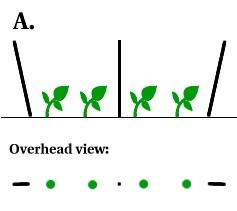
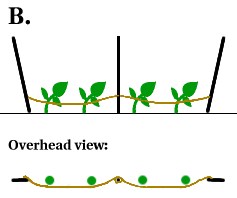
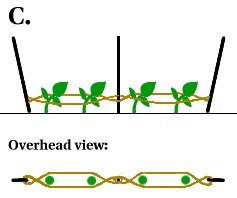
A. Space the tomatoes as you normally would; I use three feet apart, but I've known people to do it as close as 18 inches in excellent soil. Drive one stake for every two tomatoes, with stakes on the end. Angle the end stakes outward to take the weight.

B. Using heavy twine, tie a line about 8-10" above ground level on an end stake. Run the line on one side of the next two tomato plants (the front side), then to the back side of the post; take a turn around the post, and run on the front side of the next two plants. Pull it as tight as you can.

C. When you get to the end, return the opposite way: the back side of the plants, the front side of the posts. This pulls each line in toward the center, sandwiching the plants; if you don't "weave" it this way, the plants will tend to lean out more.

Run lines every 8-10" high as the plants grow, and tuck new vines in every few days. No pruning is necessary, though I tend to prune shoots below the first line of twine to keep things a little neater around ground level. As the season progresses, the twine will stretch a little, so be prepared to take up the slack in some way -- many people take a small stick and "tourniquet" the line to keep it taut.

Even if you fall behind a bit (who doesn't?) all is not lost. If the plants have grown a foot above the last line, add another line and wrestle all the growth into the top line, then start tucking farther down. The vines don't have to be inside every line, just enough of them to keep the plant from flopping around. As time goes on, you may very well run out of pole, too; just let them fold over somewhere past the top, then begin tucking them into the weave wherever they come down. You'll have a wall of foliage by season's end, but that was sort of the idea.

I haven't come upon a real deal-breaker with this method yet. It's cheap, as you can recycle posts (you can even find used ones sometimes, and save having to buy them) and all you need every season is twine; it's easy to store, since you can compost the twine and stack the posts. The plants grow up off the ground and fruit is easy to find and pick, but there's enough foliage to prevent sunscald. The most irritating thing is keeping the lines taut, but even that gets more routine with practice, and it's an occasional task, not constant.

All in all, I prefer it to the common alternatives of staking or using cages made of concrete reinforcing wire. If you have any questions, drop me a line.

Wednesday, January 03, 2007

Record low rainfall in Central Florida

DeLand saw its lowest summer rainfall total ever...

2006 one of the driest years on record...

2006 will go down as one of the driest years on record across east-central Florida. The dry conditions can largely be attributed to the strong influence of enso (el nino-southern oscillation) on Florida weather. Last winter and Spring were dominated by La Nina... which typically results in drier than normal conditions across the state. Rainfall deficits continued during the Spring and early Summer... resulting in an increase in devastating wildfires across the area. El Nino conditions developed during the Summer which had a significant impact on tropical storm and hurricane development in the Atlantic Basin. The general lack of tropical activity across the region contributed to additional rainfall deficits during the late Summer and through the fall... when significant rainfall is often quite common across the area. El Nino
conditions are expected to continue through early 2007... which will likely result in above normal rainfall through the remainder of the dry season.

Below is a list of some notable rainfall totals from around the
forecast area:

Location 2006 rainfall total rank record low rainfall/year
Deland 37.09 inches 1 39.28/1974 (previous)
Stuart 37.77 inches 1 38.02/1981 (previous)
Daytona Beach 31.39 inches 2 31.36/1956
Lisbon 32.66 inches 2 29.26/2000
Vero Beach 33.56 inches 2 32.70/1961
Orlando area 36.35 inches 3 30.38/2000
ft Pierce wp 33.84 inches 3 30.07/1917
Sanford wp 37.25 inches 5 32.83/2000
Sanford Arpt 41.27 inches 6 33.16/1967
Melbourne 39.95 inches 7 31.97/1981

Tuesday, January 02, 2007

True Blue Propagation

True Blue Propagation
Welcome to True Blue Propagation True Blue Propagation only grows and sells premium blueberry plants. We specialize in providing State inspected plants to farms all over the America.

We provide detailed written growing instructions when you purchase our blueberry plants. It helps you with site selection, soil preparation, watering, mulching, fertilizing, harvesting and handling. We recommend ordering a minimum of 2 plant types for optimal cross-pollination.

True Blue Propagation only grows America's best blueberry varieties. Our intent is that you receive only the highest quality blueberry plants. Your plants arrive rooted in a good portion of moist soil.

Emerald
Early. Bush is vigorous and spreading. Fruit is very large, firm, medium blue, with excellent flavor and a small scar.

'Emerald' was released as a patented variety by the University of Florida in1999, and is currently one of the more widely planted varieties in north-central Florida and appears to be adapted from Gainesville to Sebring. Emerald combines a vigorous, upright, bush with high yield potential, early ripening, and large, high-quality berries.

Emerald flowers open uniformly, and it produces abundant leaves even after mild winters in Gainesville. Because the plant is highly vigorous when planted on suitable soils, Emerald is capable of carrying heavy crops.
Jewel
Early. Slightly spreading, highly vigorous bush. Highly productive. Fruit is large, light blue, small scar with a slightly tart flavor.

'Jewel' ( Fig. 2 ) is a patented release from the University of Florida breeding program with a moderately low chilling requirement, very early ripening, and high berry quality. Jewel appears to be adapted to the region of Florida from Gainesville to Sebring.
Princess
Saphire
Early. Bush has medium vigor, semi-spreading. Fruit is medium sized, light blue, very firm, small scar, with a pleasant aroma and excellent balance of sweet and tart flavors.

Sapphire was developed by the University of Florida to fill the need for lower chill varieties. Sapphire sets a high ratio of berry buds so pruning will be important for optimum berry size and plant growth. We recommend Sapphire for trial in low chill areas where winter frosts are uncommon. Chilling hours are estimated at 200.


Star
Star has not performed well south of Ocala where it tends to produce few flowers and has weak growth. Average date on which Star reaches 50% bloom in Alachua County is February 23.
Windsor
'Windsor' is vigorous, with stout stems and a semi-spreading growth habit. Windsor appears to be best adapted to north-central Florida but has been grown successfully as far south as Hardee County. The mean date of 50% open flower in Alachua County averages about February 21, about 3 days after Sharpblue and about 3 days before Star.

Windsor leafs out strongly as it begins to flower, and this strong leafing enables it to support a large crop. In Alachua County, the first commercial hand harvest on Windsor (10% of the crop ripe) averages about April 12, and 50% of the berries are normally ripe by April 24. Windsor berries are very large.
Sebring is in Highlands County, at about 27 degrees latitude.

Saturday, December 30, 2006

Frost & Freeze Occurence Dates for DeLand

Very useful information....

Temp.

Spring Date

Fall Date

Probability Level

Probability Level

Station

Threshold

90%

50%

10%

10%

50%

90%

Deland

32

Jan 21

Feb 19

Mar 21

Nov 13

Dec 10

Jan 06

28

-

Jan 28

Mar 03

Nov 30

Jan 04

-


So, planting any frost-tender plants before the third week of January seems risky at best. If you wanted to be pretty sure, you'd wait until the beginning of March. In the fall, you'd want to aim to harvest any tender crops before the end of the first week of December.

My order from Tomato Growers Supply Company


#5606 - Matina - 30 seeds.
This very early variety bears loads of 2 to 4 oz. red fruit with terrific flavor normally found only in a huge beefsteak. The fact that its fruit is ripe up to a full month earlier than many beefsteak varieties makes Matina really special. Potato-leaved plants put on large clusters of abundant tomatoes, and even though they start early, continue to bear throughout a long season. Heirloom from Germany. Indeterminate. 58 days.
#5219 - Tiffany VFNT Hybrid - 30 seeds.
Vigorous plants produce loads of smooth 6 to 8-oz. dark red fruit with full, rich, sweet flavor. This is an excellent all-purpose tomato that adds intense tomato flavor to salads and sandwiches, but is also great for sauce, canning and freezing. Strong plants are also resistant to gray leaf spot and leaf mold. Indeterminate. 70 days.
#5759 - Wild Cherry - 30 seeds.
#6313 - Sun Gold Hybrid - 30 seeds.
Very sweet, bright orange cherry tomatoes taste not just sugary but also fruity and delicious. Vigorous growers, these tall plants bear long clusters of fruit. Try these for a real taste treat, you won't believe you're eating tomatoes! Indeterminate. 57 days.
#6166 - Yellow Currant - 30 seeds.
A special South American species of tomato that bears long, grape-like clusters of tiny 1/3 inch yellow cherry tomatoes. They are sweet, yet have an intense tomato flavor. These tiny tomatoes have become favorites for salads, garnishes or just eating straight off the vine. Indeterminate. 70 days.
Peppers:
#9660 - Sweet Spot X3R Hybrid - 30 seeds.
This high-yielding banana type pepper produces an incredible harvest of mild, sweet peppers about 8 in. long and 2 in. wide with much better size and thicker walls than open-pollinated banana types. Peppers may be enjoyed at any color stage-yellow, orange, or bright red. Tall plants resist 3 races of Bacterial Spot. 70 days.
#9160 - Italian Roaster II Hybrid - 30 seeds.
Expect loads of these long, thin green peppers with just the right amount of heat to spice up a meal. The 8 to 9 inch long fruit is about 3/4 inch wide at the shoulder with thin walls that make them perfect for grilling. Just char on two sides and they're ready to eat, seeds and all. You can harvest some as they turn red also. They are particularly good on top of a burger or other sandwich. Virus resistant, medium-large plants. Slightly hotter than the original. 76 days.
Eggplants:
#7033 - Little Fingers - 30 seeds.
These little eggplants are unique in that they grow in clusters of 3 or more slim fruit, and can be harvested when no longer than your little finger. However, you can also let them grow longer at no sacrifice to their mild, sweet taste. Dark purple fruit is produced in abundance, and is delicious stir-fried, grilled, or even pickled. 68 day.

Goings on in the garden...

Ah, another balmy, March-like day in December. This global climate change is great for the winter garden here in Central Florida, but I wonder at what price... My new dwarf citrus are blooming like crazy, a couple of months at least in advance of when they should be blooming. The Flordabell peach and all the blueberries continue to put out blooms. The Chandler strawberries have tons of fruit, as they should this time of the year. The Sweet Charlie berries that I got mid-December as bare-roots have put out ample and vigorous growth. The peas, sweet and garden, have grown a foot in two weeks, and the favas are going crazy. In roughly three weeks, they have sprouted and grown at least four inches. Some of them have put multiple shoots from the same bean. The Broccolini di Rapa that I planted a week ago in cells got transplanted into the garden, along with the spinach and chard from the first week of December.

I also finished off two small additions to the flower beds, again using the mulch method. The whole process has taken about a month: I started by sowing very heavily with annual rye, and then covering, lightly, the rye seeds with wheat straw. After about two weeks, I had a thick bed of rye and wheat growing up, along with some slightly composted hay. To that mix, I dumped several bags of leaves pilfered from neighbors' yards, and mowed the whole mess down to the ground with my mulching mower. The rye and wheat sprouted back, and I repeated the whole enterprise of leaves and mowing two wees later (last week), adding some garden waste from cleaning out beds (mostly Althernatera, which is lovely but too prolific...). Yesterday, I finished the project by mowing down everything, layering a bucket of alfalfa pellets upon that, then topping it all off with several layers of newspaper, to provide a weed block. On top of the newspaper, more shredded leaves and a thick layer of pine straw. The final result: About three inches of finely ground compost beneath the newspaper, and a couple of inches of growing medium on top of the newspapers.

To plant seedlings, I just shove the mulch aside, make a little tear in the newspaper (an arguable step, since the roots can penetrate the newspaper), add a handful of bagged compost, plunk down the seedling, draw the leaves and pine straw back into place, and move on. No shovel, no fertilizer, no nothing else. The first few times that I planted seedlings this way were pretty angst-ridden: Gardeners are so wedded to the "dig a hole, enrich the hole, plant the seedling" process that it was something of a leap of faith to just gently place a seedling on the ground.

But who can argue with success?

Wednesday, December 27, 2006

Peach blooms in December...


After our week of warm weather -- a week that saw a number of high low-temperature records sets, and three tornadoes on Christmas day in our area -- my new Flordabell peach tree decided to have a small fit of blooms. I'll pinch them off tomorrow, but they were too pretty today. My blueberries, particularly Emerald, are also flowering:


Saturday, December 23, 2006

More quick notes from the garden...

I planted today...
  • eighteen Broccoli di Rapa (from Pinetree): thirty days
  • nine Delfino Cilantro (Pinetree)
  • nine Agina Cutting Celery (Pinetree): sixty-three days
  • half a window box of Reggae Raddish. Supposedly very resistant to splitting.
We had another deluge last night... about two inches, judging by buckets in my yard. Thank you, Mr. Nino! Yesterday I staked a bunch of my delphiniums, which were gorgeous. Last night's downpour snapped them in half, right where I'd tied them. Sigh.

The Sweet Charlie bare-root strawberries that I planted yesterday have already put out new growth:

Finally, on a non-gardening note: My family and I took an impulse run to Lake Woodruff Wildlife Refuge this evening on the off-chance of spying the pair of Whooping Cranes that have made the area their winter haven. We caught them just as they returned to the area, amongst a large flock of Sandhill Cranes, far off in a remote section of the refuge:

There are, at best, a few dozen of these cranes in Florida, a few hundred in the USA.

Eve of Christmas Eve Garden...

Posted by Picasa