Wednesday, June 14, 2006

Blossom to Table: Honey Grows Up - New York Times

I'm reading Robbing the Hive right now, so this article in the NYT piqued my interests. I love bees: Every morning, I spend a few moments near my gaura and basil plants, listening to their contented hum. Another symptom of my biophilia.

I hope this interest in artisanal honey continues -- by the nature of its production, it tends to be a small-operation and local agricultural affair, readily available practically anywhere there are flowers.

The article errs when it remarks that tupelo honey is a product of Georgia: It's produced everywhere in the Florida panhandle, where the tupelo tree grows abundantly in the marshy river flats. There are native tupelo trees in North America, but I'm fairly sure that most of the ones in Georgia and Florida are introduced species from Asia.
Blossom to Table: Honey Grows Up - New York Times: "June 14, 2006
Blossom to Table: Honey Grows Up
By DANA BOWEN

TED DENNARD, founder of the Savannah Bee Company, says 2004 produced the best orange blossom honey the South has seen in decades.

But you never know. 'Last year was an awful year for basswood,' said Zeke Freeman, owner of Bee Raw Honey, blaming an early summer drought in New York.

And Neal Rosenthal, who imports Mario Bianco brand honeys from Italy, in rare flavors like dandelion, lime blossom and eucalyptus, wistfully recalled, 'We still talk about the remarkable chestnut honey of 1983.'

It's apt that Mr. Rosenthal imports wine as well as honey. Many of the same factors that distinguish a reserve cru from a pitcher of house red — a distinct varietal, a particular place, propitious bursts of sun and rain — determine whether honey is packaged in a costly jar or pumped into a plastic bear-shape bottle. And with more single-flower honeys on store shelves and farmers' market tables, chefs have been dispatching their wildly different flavors to dishes the way sommeliers pair wine with food."

Wednesday, June 07, 2006

Joe Freeman's Favorite Roses

Not long ago, I condensed and reproduced a list of reliable and easy to care for roses for Central Florida. Here's another list of favorite roses, this one from the excellent book, The Florida Gardener's Book of Lists by Lois Trigg Chaplin. Joe Freeman, according to the book, is the chief horticulturalist at Cypress Gardens. I've starred the roses that were also mentioned in the Orlando Sentinel's best rose list.

Abraham Darby* (English)
Belinda's Dream* (Shrub)
Carefree Beauty (Floribunda)
Chestnut Rose (Rosa rosburghii)
Gold Medal* (Grandiflora)
Heritage* (English)
Louis Phillipe* (China)
Maitland White (Noisette)
Mr. Lincoln* (Hybrid Tea)
Mutabilis* (China)
Nur Mahal (Hybrid Musk)
Old Blush (China)
Othello (English)
Pink Pet* (Polyantha)
Prosperity* (Hybrid Musk)
Smith's Parish (Bermuda)
Sombreuil (Climbing Tea)
Spice (Bermuda)
St. David (Bermuda)

Thursday, June 01, 2006

Figs Believed to Be First Cultivated Fruit - New York Times

I love figs! Our old neighbor has a truly massive brown fig tree planted in her swale. It never gets irrigated, and receives full-day direct sun. She doesn't eat figs, which meant they were ours for the picking. I recently bought a small fig tree; when the rainy season starts (if it starts!), I'll plant it out at the corner of our property.

Figs Believed to Be First Cultivated Fruit - New York Times

On This Old McDonald's Farm, A First Hint of Agriculture: Figs

In the ruins of a prehistoric village near Jericho, in the West Bank, scientists have found remains of figs that they say appear to be the earliest known cultivated fruit crop, perhaps the first evidence anywhere of domesticated food production at the dawn of agriculture. The figs were grown some 11,400 years ago.

Presumably that was well after Adam and Eve tried on the new look in fig leaves, in which case the fig must have grown wild in Eden.

Two botanists and an archaeologist, who describe the discovery in today's issue of the journal Science, said the figs came from cultivated trees that grew about 1,000 years before such staples as wheat, barley and chickpeas were widely domesticated in the Middle East. These grain and legume crops had been considered the first steps in agriculture.

The researchers uncovered nine small figs in the ruins of a burned building. The fire left the figs charred, preserving them in a condition for detailed analysis. The researchers established the age of the cache by dating the fire's remains.

A comparison with modern wild and domesticated varieties, the scientists said, led them to conclude that the ancient figs had undergone a mutation in the wild that produced a sweet fruit but no fertile seeds.

Because these trees were a reproductive dead end, the botanists reasoned, they could have been propagated only by people planting shoots of the variant strain again and again. A piece of stem stuck in the ground will sprout roots and grow into a tree, which could explain why figs were domesticated much earlier than grapes, olives and other fruit plants.

The archaeobotanists who conducted the study were Mordechai Kislev and Anat Hartman of Bar-Ilan University in Israel. Their co-author of the journal report was Ofer Bar-Yosef, an archaeologist at the Peabody Museum of Harvard.

In an interview by telephone from Israel, Dr. Bar-Yosef said that he was ''confident about the identification of the figs as being of a domesticated variety'' and that they were probably the earliest known domesticated crop. The cultivation technique, he said, seemed to be well enough advanced to suggest that people had thus been intervening in nature for several centuries.

Dr. Bar-Yosef noted that the experimental technique of repeated plantings was similar to the methods by which hunter-gatherers collected wild grains and legumes and gradually developed cultivated crops.

Over the last century, scientists have scoured the Middle East for traces of the origins of agriculture and argued over what the first crops were and where they were grown. Dr. Bar-Yosef contends that the first cultivated grains were introduced in what is now Israel and north into the upper Euphrates River valley. Other researchers think the most likely origins were in southern Turkey.

But scholars agree with Dr. Bar-Yosef that the beginning of agriculture, whether with the first sweet fig or ripe grain, was pivotal in human cultural evolution.

''Eleven thousand years ago, there was a critical switch in the human mind -- from exploiting the earth as it is, to actively changing the environment to suit our needs,'' Dr. Bar-Yosef said in a statement from Harvard. ''People decided to intervene in nature and supply their own food rather than relying on what was provided by the gods.''

Sunday, May 28, 2006

The Best Roses for Florida

The Orlando Sentinel published a list of favorite roses from the Central Florida Rose Society. The criteria included:
  • Continual bloom (good luck!)
  • Floriferous
  • Disease resistance
  • Relatively carefree (I have no idea what that could mean – all roses here have roughly the same needs.)
Here goes the list, with the top seed in bold:

Hybrid Tea
  • Double Delight
  • Mr. Lincoln (I grow it – a very vigorous, wonderful plant.)
  • Veteran’s Honor
  • St. Patrick (An excellent, very upright narrow bush with tight buds. The best rose for cutting, lasting a remarkable week or more.)
  • Elina
  • Loise Estes
  • Bride’s Dream
  • Gemini
  • Moonstone
  • The McCartney Rose
Shrub Roses
  • Knock Out (I grow both the original cherry red and a very pretty light pink sport. First-rate landscaping rose, seemingly immune to black spot (not just resistant to it). Low water needs.)
  • Belinda’s Dream
  • Dortmund (A Kordes rose. Reputedly very disease resistant. I’ve not seen it for sale on Fortuniana rootstock, though.)
English Roses
  • Abraham Darby (A standout in my garden, too.)
  • Heritage
  • The Prince
  • Charlotte
  • The Dark Lady
  • Graham Thomas
  • Molineux
Grandiflora
  • Gold Medal (I bought under the name of AROyqueli. It was so diseased and stunted I got it for $1.50. So far, it’s doing well, but not many blooms.)
  • Queen Elizabeth
  • Cherry Parfait
  • Tournament of Roses
Miniature Roses
  • Bees Knees
  • Butter Cream
  • Fairhope
  • Jean Kenneally
  • Jeanne Lajoie
  • Figurine
  • Miss Flippins
  • Kristin
  • Pierrine
Climbing Roses
  • Don Juan (An exceptional, vigorous, disease-tolerant rose. Don Juan is an oddity: At any point, it will have all stages of flowers, from new shoots, to bud to blown. The vast majority of roses go through cycles of bloom, where all the flowers are roughly in the same stage of bloom.)
  • Prosperity (Another great recommendation. Extremely vigorous and disease resistant.)
  • Fourth of July
  • Cecile Brunner (Very vigorous, growing on its own rootstock. I bought mine for $4.50 from Seminole Springs Nursery. I planted mine a few months ago, and though it hasn’t bloomed, it’s already mounted my six-foot fence.)
  • Altissimo
  • Clotilde Soupert
  • Red Cascade (I’d classify this as a rambling miniature rose. Perfect tiny red blooms. It grows very well in a small cage or tripod. Floriferous and the toughest rose I’ve ever grown.)
  • Champney’s Pink Cluster (Bred by Champney in South Carolina. It’s the parent of the Blush Noisette and all the innumerable offspring of that rose.)
  • Marechal Niel
Old Garden Roses: I grow many of these, all of them purchased from Seminole Springs Nursey.
  • Louis Phillippe
  • Mrs. B. R. Cant
  • Souvenir de la Malmaison
  • Mutabilis (There’s a wonderful example of this rose growing at Freedom Playground here in DeLand.)
  • Pink Pet
  • Blush Noisette
  • Duchesse de Brabant
  • Paul Neyron
  • Cramoisi Superieur
Floribunda Roses
  • Our Lady of Guadalupe
  • Iceberg (My first rose!)
  • Playgirl
  • Sun Flare
  • Miss Ada
  • Hannah Gordon
  • Betty Boop
  • Europeana
  • French Lace

Garden Visitor

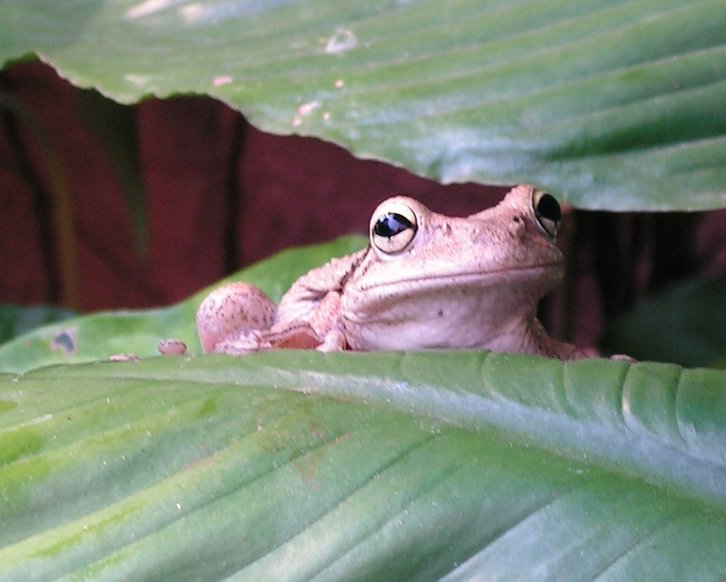
We have several species of tree frogs living around our house. This is one of two who live behind a wall fountain on the patio. They usually come out only at dusk, but it's mating time. The utter wreck of a garden fountain I installed this winter (I must replace it!) is full of tadpoles at all stages of maturity, to the constant entertainment of my son.

Tuesday, May 23, 2006

Dahlias in Central Florida


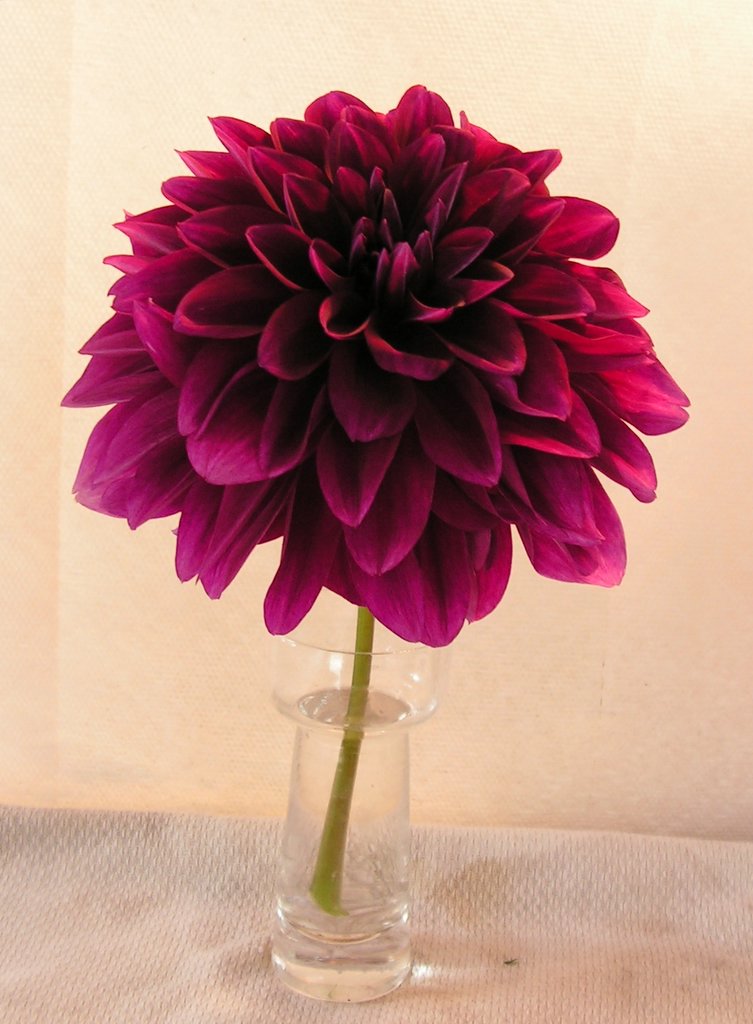
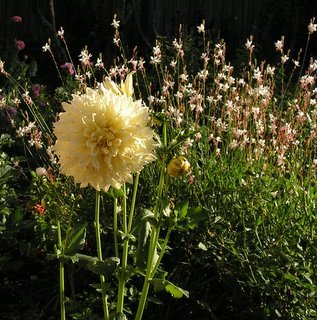
My dahlias continue to thrive... This is a lateral which I should have disbudded, but given that this is new territory for me, I opted for more flowers earlier with shorter stems.

Sunday, May 21, 2006


A brown anole (Anolis sagrei) inflating its dewlap early one May morning. The plant in the background is an African Blue Basil, a 2006 FNGLA Florida Plant of the Year, and one of my favorite plants in the garden. It is somewhat camphory (like Thai basil, though Thai is more minty), and I don't care much for its culinary uses, though I still use it when my Mediterranean basils have burned out in September. The African basil grows from spring to frost, covered in long blue spikes. The flowers themselves are small, bluish white and short-lived, but the blue calyces (modified sepals that look like flowers but are not) last for weeks. It sprouts readily in a glass on the windowsill, and has always come back from the root after a frost. Mine was hit hard by the cold here in January, and is just starting to come back into bloom.

The reason I love the plant, beyond its landscape value, is its attractiveness to honey bees. I visit my basil corner every summer morning, to marvel at the seething buzzing multitudes that hover about it.

Tuesday, May 16, 2006

Delphiniums in Florida

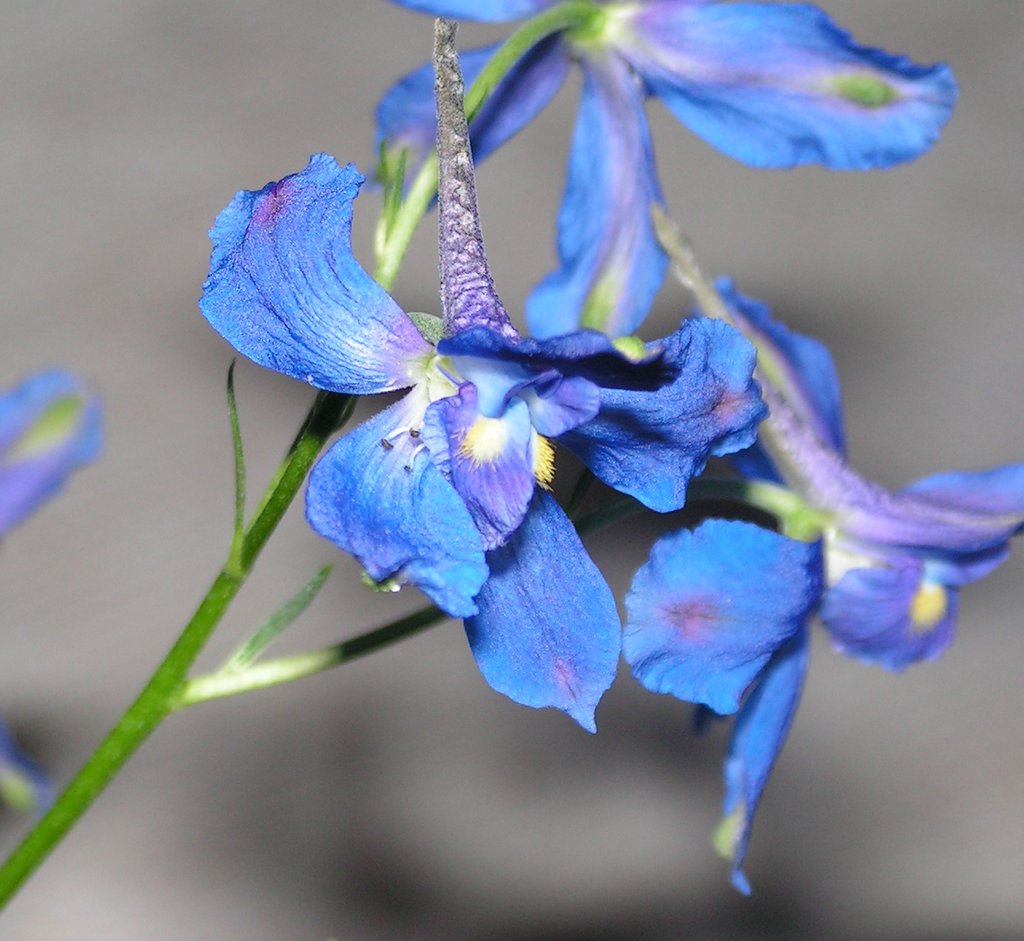
Mediterranean Seas (Delphinium tatsienense) from Thompson & Morgan. I started these a bit late, in February or March, but they seem to be going strong in the back of my bed. Not the tallest delphiniums at only 30 inches, but they're an intense blue and they seem to handle the heat with little complaint.

An addendum: This particular Delphinium makes a first-rate cut flower. It looks as good six days after cutting as the first day -- the best vase-life of any cut flower I am currently growing.


Sunday, May 14, 2006

A family of milkweed beetle (Tetraopes tetraophtalmus) enjoying the butterfly flora at Leu Garden. Posted by Picasa

Friday, May 12, 2006

Chrysanthemums


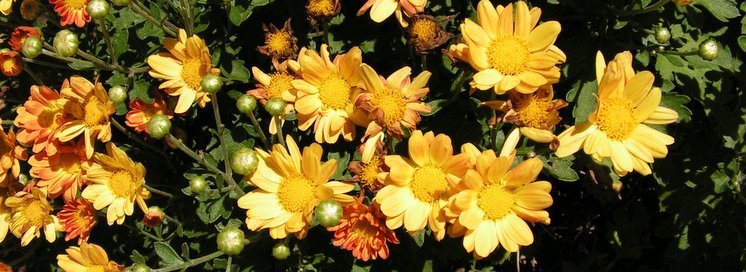
More true perennials for Florida: Up North, people think of mums as plants for fall. Here, though, Mums have two seasons: I buy them in early fall for some quick color in pots when everything else has died or has yet to recover from the rains and heat of September. Once the plants go out of bloom (usually a month or so), I chuck them in a sunny corner where it's easy to water them from time to time, and then wait the four months until they come back into bloom, right at the end of spring. If I were really really patient, I could then transplant them into a lightly shaded corner of the garden and they would bloom again come fall. Posted by Picasa

Sunday, May 07, 2006

Bulbs of FLA...


Because we can't grow (perennially, in any case) tulips, hyacinths and daffodils, there's a strange idea common to Central Florida that we cannot grow bulbs at all. That's far from the truth, though gardeners need to choose their bulbs carefully. (Now, of course, the pictures above and the discussion here is not limited to bulbs, but includes rhizomes (and their ally, the tuber) and corms. These are distinct storage organs, but from the gardener's perspective, there's really little difference.) As a rule of thumb, we can grow virtually any bulb if planted at the right time of the year, including tulips and daffodils. However, many bulbs from temperate climates can't cope with Florida's heat, humidity, and "soil." Bulbs from the southern hemisphere, particularly from South Africa, do very well here. I don't mean this to be a comprehensive list, but here goes with the bulbs I have grown in my garden, with some comments on their performance:
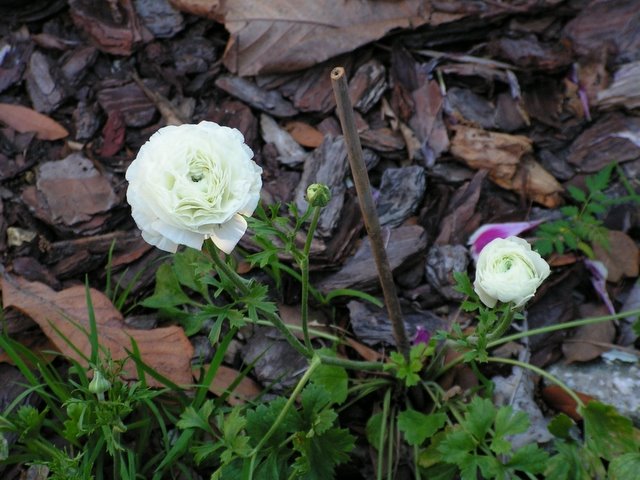
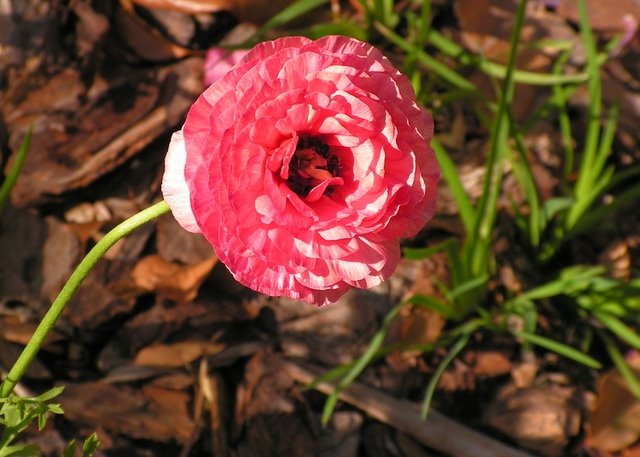
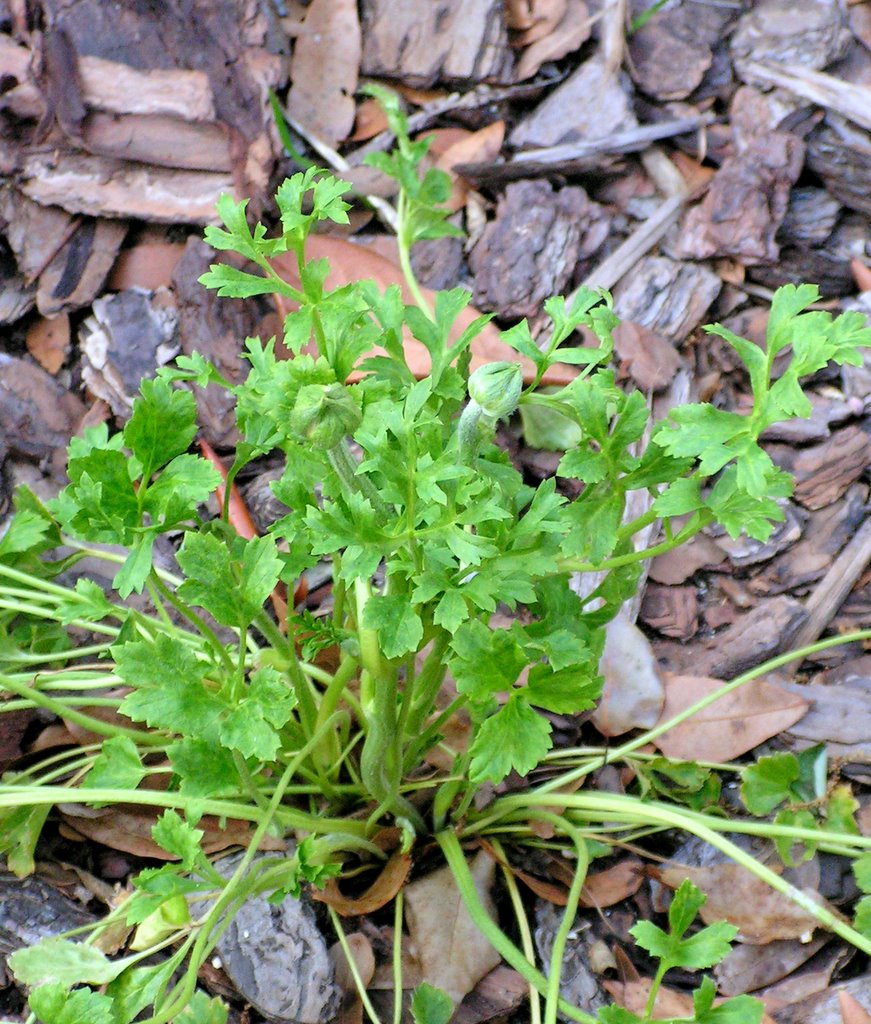
  • Ranunculus asiaticus (Persian buttercups): Plant as soon as cool weather starts. I remember reading somewhere that the name means little frog (rana in Latin). That might incline you to believing that they grow in marshy, wet soil (which would be entirely wrong -- they're actually sold as xeriscaping bulbs); I think the name more likely comes from their star-shaped, crinkled rhizomes, which look a lot like little frogs. I planted these in too shady a spot this year, and by the time they bloomed, we started to have our typical intermittent heat waves. Still, I had several dozen lovely blooms for a small investment. Next year -- rich soil, full winter sun, plant in early November.
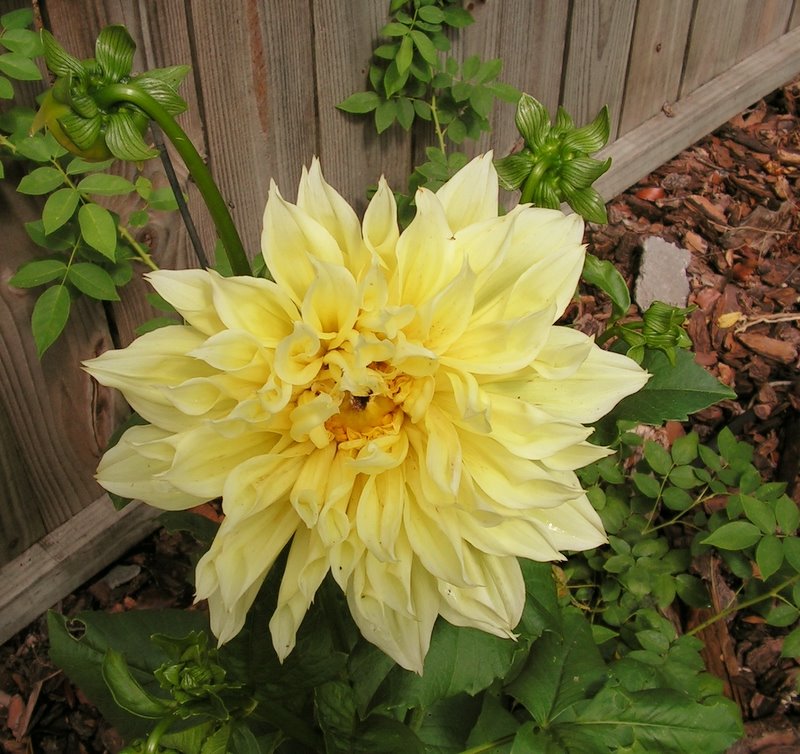
  • Dahlias: This is my first year growing them, as many gardeners and books had instructed me that they don't grow here. Nonsense. The trick for me at least was to plant them (in full sun and fairly rich soil) at the beginning of February: They started to bloom in mid-April. There was the risk that a late frost might have killed them, though. I bought cheap, generic tubers from Lowes, but have been very happy -- I have 6 plants growing, two blooming; the others are too small to bloom now, but might still do so this season. (They are the yellow and burgundy blooms in the photos above.) I mistakenly divided the tubers when I probably should have kept them all together. I predict that these will continue to bloom as long as they are watered well. I'll pull them as soon as it's obvious they are rotting (which they will inevitably do, once the rainy season starts).
  • Dietes (several species): My comments from Daves Garden:
Sturdy, ultra-low maintenance plant here in Central Florida. It grows rapidly -- even very small, one-gallon plants grow within three years to 2-3' or more in diameter.
Grows best in filtered light here in FL (direct sun farther north), but I have it in full direct sunlight in the swale and it's doing well in those tough conditions, though the leaves are not as deep green. Flowers best in sun, but even in full shade it flowers and grows. Blooms in flushes, with large flowers in the cool season and smaller ones when it's hot. Makes a beautiful cut flower, though lasts only one day.
It does self-sow, but the seedlings are easy to recognize and shallow-rooted.
Note: These plants, when large, are VERY difficult to dig and divide. I have dug and divided monster clums of 4' -- it took me more than an hour to pull the plant out of the ground and another hour to cut the plant into manageable clumps. That said, the one large clump produced 10 medium plants that are now filling a bed.
  • I can't praise highly enough the freesia I bought from easytogrowbulbs.com. They have provided a full spring of blooms. In my garden they grow in completely unimproved, though heavily mulched, soil under partial shade. They aren't demanding, don't take up much space with their small, sword-like foliage, and have already put out new growth. They say you can leave them in the ground, and given their relatively low price, I'll give it a shot this year.

  • To be continued...


Stokes Aster


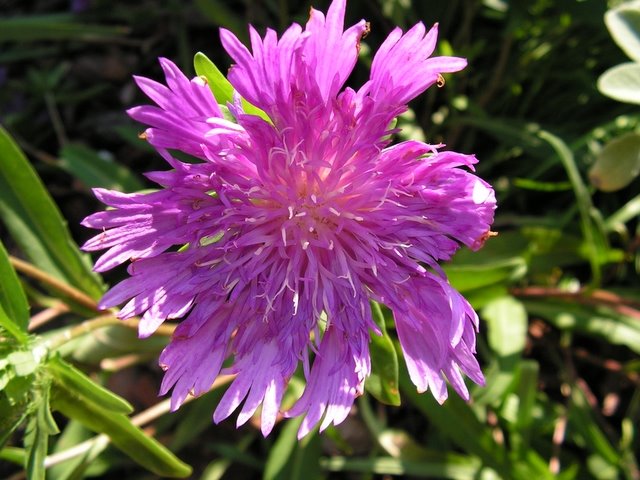
Stokes Aster (Stokesia laevis) is another reliably perennial herbaceous (as opposed to a shrub) plant here in Central Florida. When dormant, it looks like fat liriope (which, by the way, is unaccountably pronounced luh-rye-o-pee -- surely the second least predictable pronunciation after kalanchoe, which, trust me, is correctly pronounced (per Greek norms) kal-in-kow-ee).

Anyway, back to Mr. Stokes. Best grown (like most on the perennials here) with some afternoon shade. Mine has been thoroughly abused (replanted twice in the cool season) and continues to thrive. The first year I got, maybe, 10 blooms. This year it's been non-stop blooms for weeks. Makes for an interesting cut flower which lasts for at least three days. The downside (at least through year two) is that the stems are too short for really interesting cuttings: If you were to take a long stem (say 18"), you'd have to sacrifice a bloom in bud. You could do it, but it would be a pity. Maybe next year the plant will put out sufficiently long stems, or sufficiently large that I won't miss the bloom.

It's native here in Central Florida. If that matters to you. I haven't seen any seedlings, but it's clearly divisible: Fat, tangled roots, not unlike (again) liriope. (Liriope is in the lily family, while Stokes Aster is (predictably) in the Asteraceae.)

Saturday, May 06, 2006

Grandmother Greer's rose

I got this rose from my grandmother's farm in Bardstown, KY as a small, sickly rooted cutting. My grandmother had it growing for fifty years, up a bell pole on the farm; planted in that red clay, it's wonder it grew as well as it apparently did. (That bell now lives in Florida, too. I have a 'Don Juan' and 'Prosperity' growing up its pole now. My mother tells me that the bell was only rung in emergencies; my son and daughter, on the other hand, ring it nearly every week, just to delight in the sound. When I mounted it a few years ago, I noticed that it was a school bell, with the year and PS number carefully etched onto the inside. I should have jotted down that information, since now 'Don Juan' is tangled up inside the bell's skirt.)

I don't ever remember seeing this rose in bloom on the farm, but my mother says that some years it was a blanket of pink.

A few years ago, I planted the Greer rose at the base of our gazebo, on a lattice. It's ambled its way up onto the roof, mixing it up with several R. laevigata that I planted there. The roof gets well above 130 degrees in July, so you know these are tough roses. They've formed a dense mat of canes from which new, vertical growth arises. It's vigorous -- I have a tough time keeping it tied up, and new basal canes are always erupting upwards and outwards.

The R. laevigata hasn't bloomed yet. I don't know this for certain, but my guess is that laevigata only blooms on old canes -- apparently older than two years. I hope to see some blooms next spring.

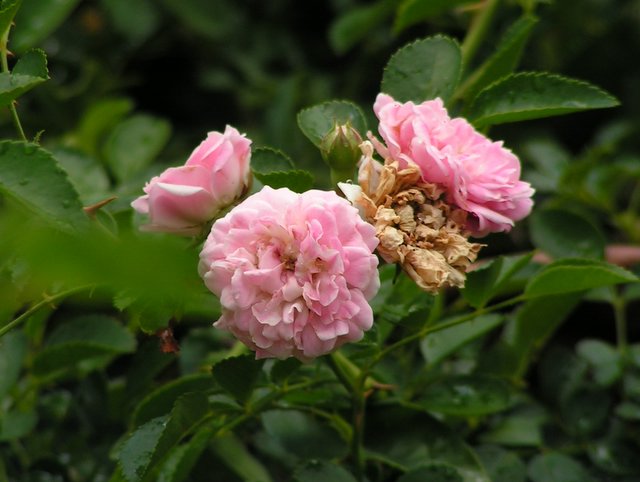
Today, for the first time, I noticed these tiny pink blooms growing on the roof of the gazebo. I almost missed them. I expect that this is just the first of (hopefully) many blooms this season. I don't know when it bloomed in Kentucky, but apparently it's a early summer bloomer here. I wonder what it is?

Saturday, April 29, 2006

Gardenias

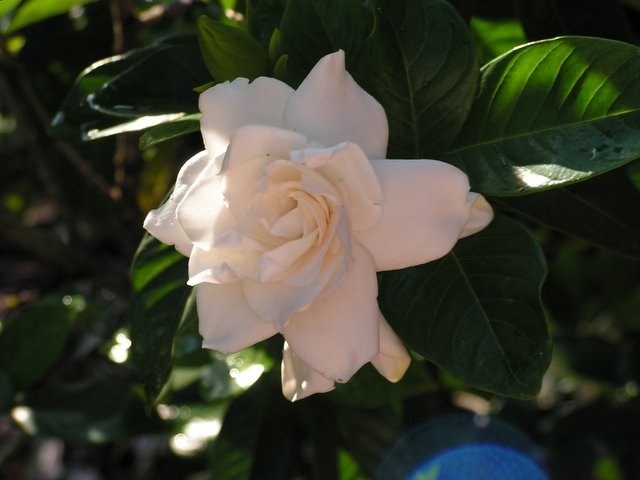
My gardenias came into bloom last week. I have a love-hate relationship with them. I love them because they're low-maintanence, elegant plants with beautiful, pinwheel-like flowers and an exotic, tropical, seductive smell. I hate them because more than a few moments in the same room with them can be too much. (I have a bunch sitting less than a foot from me as I type, and I have breathe through my mouth.) As they bloom then decline, their scent goes from exotic to just plain slatternly and strident. What's more, they don't drop, and I have to deadhead them daily or my bushes are covered in brown, gnarly-smelling blossoms.
As white flowers that bloom during the dry period, they're also constantly under attack by scale and the subsequent black soot. (Scales, tiny insects whose excretions create the ideal medium for black, sooty mold, are attracted to white flowers, particularly magnolias and gardenias.) It's fairly easy to deal with the disease, though: Soap spray and a blast from my watering gun.
Interestingly, I bought two (genetically) identical bushes (grafted Miami Supreme) two years ago. One gets a lot more sun, and seems to suffer more from the scale and mold than the other, which is in partial shade. What's more, the one in more shade is generally healthier (thicker trunk, fuller shape), with deep green leaves and abundant blooms. Supposedly gardenias should be planted in full sun, but my experience indicates otherwise.

Gaura lindheimeri

Gaura lindheimeri ("Dancing Butterflies") is a reliable herbaceous perennial here: One of the few plants that gets better every year. It's only OK as a cut flower (useful as a filler), but the bees and butterflies love it, and in my experience it's fairly drought-tolerant. It gets 8 hours of summer sun in my bed, and grows in such a way that it makes a wonderful companion for roses (pink or white).

Sunday, April 23, 2006

The end of spring...


It's been much hotter than usual for this time of April: Every day for the last week, it's gotten up into the upper 80s, often with very dry air and typical Florida sun. My ranunculus had a few more blooms before giving up the ghost (they're very heat-sensitive). The freesia in partial shade continues to bloom, but I don't see any new spikes, so my guess is in a week or so, they'll be spent. They've performed remarkably well: They started to bloom on March 6, and six weeks later I'm still cutting flowers. I plan to buy a few dozen bulbs next year.

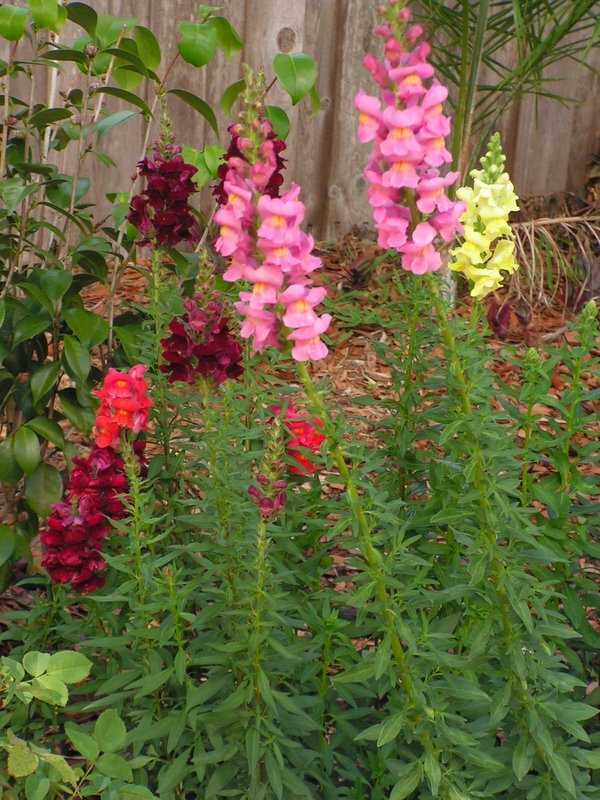
Some things are doing better than I would have expected. The "Rocket" snapdragons (from Park's) are still blooming away -- they're advertised as being very heat tolerant, and I haven't seen them droop yet this season (I do water every morning). The colors in the mixed set -- bronze, pink, pastel yellow, deep burgundy -- are rich, and the burgundy ones are very fragrant.

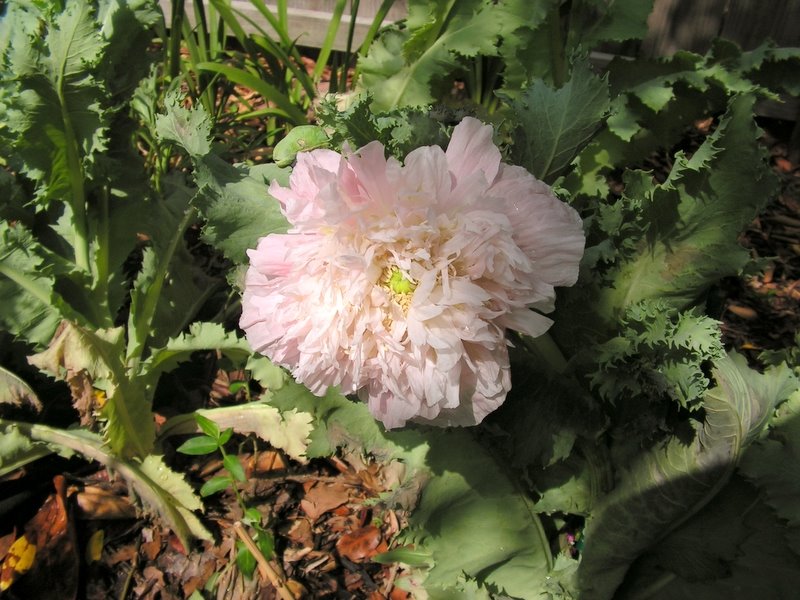
Two new blooms in my garden: The Pink Paeony Papaver (poppy) (right) that I started from seed in December and planted out into the back of my bed at the beginning of February bloomed for the first time today. I wish I'd gotten it out earlier -- it's very cold-hardy and I fear that I won't have long to enjoy the blooms. I forgot earlier this week to water one morning, and I came hope to these poor plants lying flat and wilted. It took a couple of days for them to regain their form. I planted some Papaver rhoeas, too, and they bloomed fleetingly: Beautiful and exotic, but not well adapted to spring's tendency towards heat waves. I'll definitely find the room to plant more of these Paeony poppies next season.

I bought some cheap dahlia tubers from Lowes this winter, more out of curiousity than anything else. I've never grown dahlias before and made some mistakes when I planted them mid-February, but I still have six plants growing in the back of bed. They seem to do fairly well in the sun, but they're plagued by insects on the lower leaves. They've grown vigorously -- the largest came into bloom today after only six weeks. The pale yellow is perhaps not my favorite, but given the ease and the size of the blossom, I won't complain. There are another half dozen buds on this plant, so I'm glad I staked it well early on.

There's a burgundy one in full bud now: Not as tall as the yellow, but bushier. I can't wait to see it when it opens.

Tuesday, March 14, 2006

Spring in Central Florida, Part II


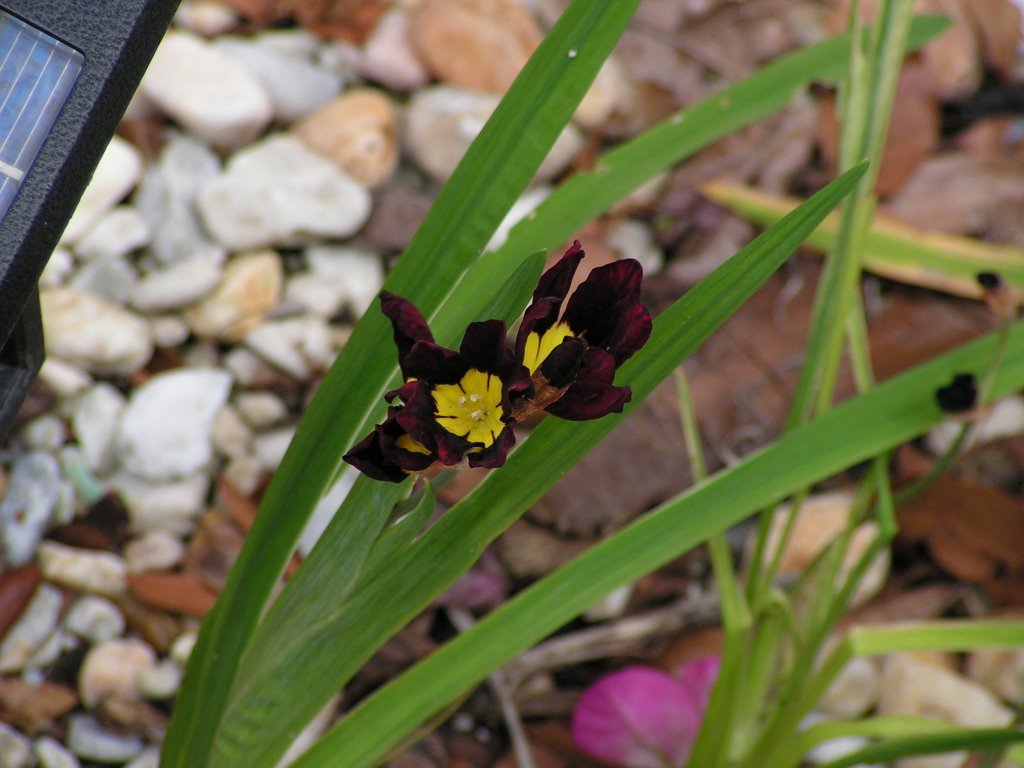
We've had some record-breaking heat (mid 80s) this past week, prompting me to finish running my water line to a spot nearer the garden, making watering a much easier task. The Chinese wisteria and Cherokee Rose (Rosa laevigata) are in bloom together at the back of my property, my Sparaxis has finally come into bloom (a meager first spike, but the flowers are beautiful), as have my Alliums and Ranunculus. My 'Blush Noisette', which I cruelly yanked from its original home back on September and plunked into a hole with little nurturing, has thrived. (The Noisettes, as a group, were developed not far from here in Georgia -- though they are known by the name of the Frenchman who popularized them.)

The spring flowers, sprouting up among the cool-season blooms and the roses, make the garden a particularly exciting place: Every day, something new comes into bloom.

Monday, March 06, 2006

Spring in Central Florida


I've been too busy, in the garden and at the office, to write much about gardening during the last month. Spring is here -- azaleas, sometimes stately and sometimes garish, are in full exaltation. Even the shabbiest house in the area is temporarily vindicated. Citrus is in bloom, with its exotic, almost cloying perfume coming in waves and making you pause in anticipation of something. The blue-eyed grass has sent out its tiny flowers that bob in the air at the ends of sometimes impossibly long stolons. The Cherokee roses in the neighborhood (but not mine) have started blooming in fits, and will continue to do so for more than a month. My ranunculus and aliums have come into bud (see below). Sweetpeas have started to flower alongside the indefatigible pansies.

The roses are taking a break -- I cleaned them up removing the deadwood and untamed canes in my OGRs, and defoliated the hybrid-teas and removed all the small canes. My climbers I leave alone, though this year they've been hit hard with blackspot and are all but bare. The canes on all the roses are already erupting in reddish-bronze new growth and the promise of blooms.

Sunday, February 05, 2006

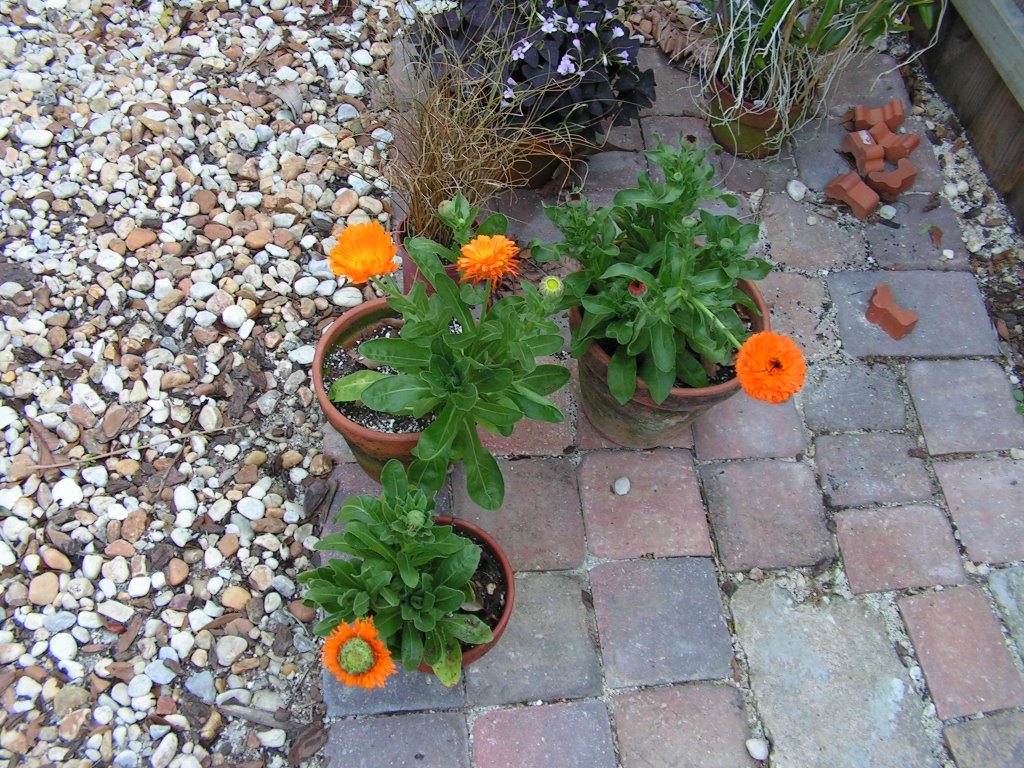
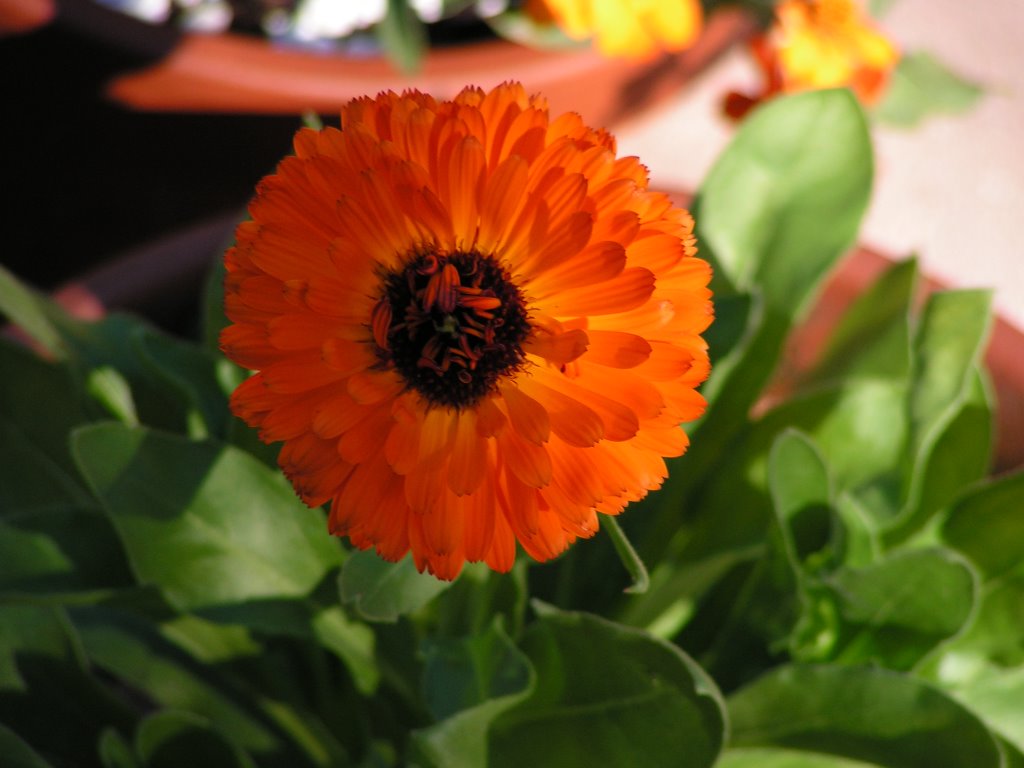
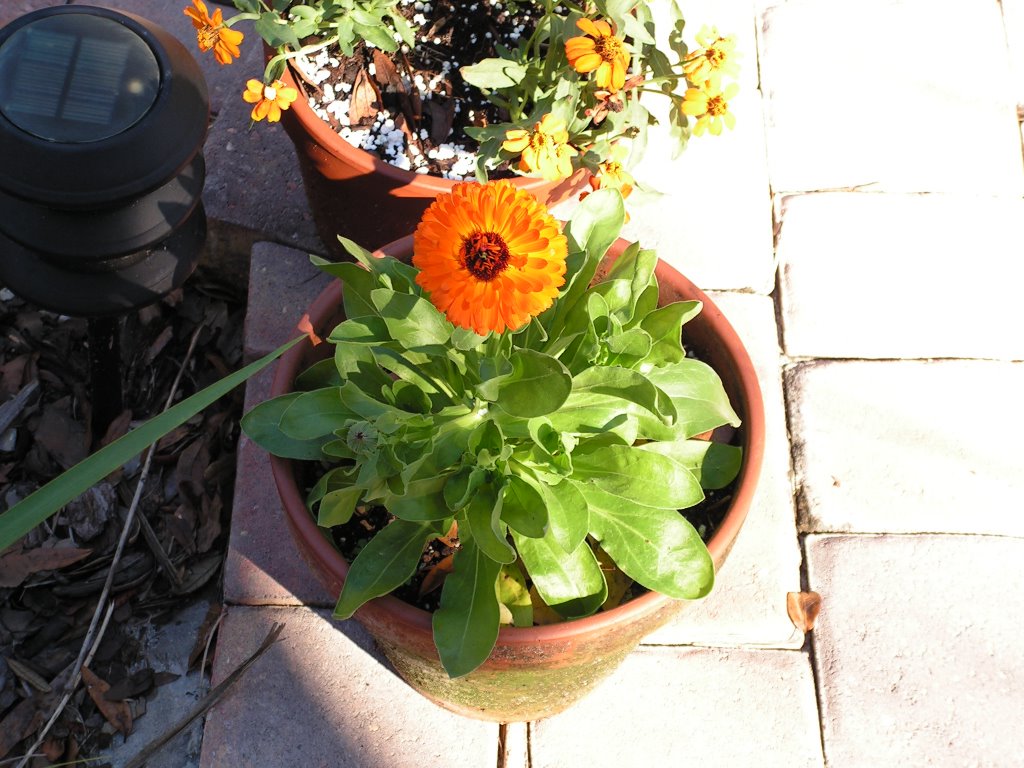
Calendula officinalis, "Pot Marigold, 'Greenheart Orange'"


Some photos of my 'Greenheart Orange' Pot Marigold, which came into bloom a couple of days ago. I don't know if I get the first part of the name, but the bloom is still opening, so perhaps it'll make sense. But I had some seconds to photograph and write about it today.

I planted Calendula seeds after reading about it in A Cutting Garden for Florida. I bought the seeds from Thompson and Morgan. I've had pretty mixed results with them: They germinate readily, but have a tendency to grow very lanky and floppy. Recently, when pricking and transplanting into Jiffy pots, I've taken to transplanting them into deep divets, with only the leaves at the level of the soil, burying most of the stem. I was worried that they would rot, but this seems to have done the trick. Of the three dozen or so of these seeds I have sowed over the past 3 months, only about a half dozen of them survived. From seed to bloom it takes about ten weeks in cool weather.

From what I've read, these do poorly in hot weather, but I figure I'll have three months of blooms from them before the May heat or June rains kill them.