
Saturday, April 16, 2011


Friday, April 15, 2011

Wednesday, April 13, 2011

Tuesday, April 12, 2011
Growing Snapdragons in Central Florida
usi aluminiu has left a new comment on your post "Snapdragons":
In my garden i can`t grow snapdragons. They need something special or i don`t know, some conditions?
Posted by usi aluminiu to Gardening in Central Florida at 8:58 AM
In my garden, all the snaps you see are volunteers from last year's crop. (Consistent irrigation (not TOO much water) is key here: When they germinate, they need damp soil.) They typically infest beds, and I pull out hundreds of seedlings every year. I also collect seed and plant it in windowboxes in September. They take a hundred plus days to mature... and they stay tiny most of the time. but as soon as the weather warms, they take off. The ones that I plant in windowboxes get transplanted throughout the garden.
My experience: They transplant well, are reasonably low in their water needs, bloom from the beginning of March (earlier, sometimes) until mid-June. SAaved seed is HIGHLY variable. But charming in its outcome: I have some peach and yellow picoteed ones out there now.
At the end of the season, let the seed pods dry thoroughly before ripping them out...
Sunday, April 10, 2011
Spring or summer in the Central Florida garden?

The title to this post presents real dilemma. I am sitting in the shade where it is still at least 83° trying to cool off after a morning of picking vegetables and tending my gardens. And on that level at least, it's clearly an early summertime here in Central Florida. We've had abundant rainfall over the last couple of weeks, at least 4 inches. It's seems the rainy season has started early this year after a cold winter. Our spring, in other words, has been cut short on both ends. But the evenings are still dry and cool and the spring flowers are sure bloomy. In the vegetable garden, I'm still harvesting spring and winter vegetables like cauliflower, broccoli and brussels sprouts. This morning I harvested my first small handful of the potatoes. I didn't dig up the plants, I just fumbled around them until I found a good size potatoes. My mother tells me that this is called "scrambling" or "scrabbling" where she grew up in western Kentucky
I tried brussels sprouts for the first time in the winter garden this year. I can't say that I met with a lot of success. They took forever to grow to any good size, and the yield was disappointing, if tasty. I made a simple dish last night of boiled cauliflower and brussels sprouts dressed with a garlicy, mustardy butter sauce. Tasty. But, not worth the real estate in the garden when it comes to the brussels sprouts.
A quick roundup of what's going on in the vegetable garden. The carrots continue to do well, I still have two long rows of them that need to be pulled sometime before May. I am harvesting the last of the broccoli and cauliflower this week. I planted out the seedlings in my garden at the end of February and am getting my final harvest in mid April. My squash plants are producing abundantly. The cucumbers are just now starting to set a lot of fruit. Tomatoes are growing vigorously and have a good number of green fruits on them. I might manage a small harvest by the beginning of May, and they'll produce until the beginning of July. (Longer for the small-fruited varieties.) Pepper plants are getting larger although still not flowering. First beans of the season should be ready at the end of this week. Chard and salad greens are still going strong but they will begin to decline by the end of the month. Finally, peaches and plums are rapidly gaining size and starting to color. They might be ready by the beginning of the second week of May.
Wednesday, April 06, 2011


Monday, April 04, 2011
Quick update
Today in the garden, I picked the first cucumber, and the first head of broccoli that I planted in my new front bed at the end of January. I also picked the last of the seasons peas and ripped out the pea plants to make room for more beans. It looks like my Ranunculus plants will start to bloom in the next few days. A good thing, considering that this steamy week has been very hard on these beautiful but delicate bulbs. Finally, I noticed that my largest tomato plants have begun to set fruit abundantly. In particular, my Tomande plants are producing very well.

Sunday, April 03, 2011
Growing carrots in Florida


Saturday, April 02, 2011

Tuesday, March 29, 2011
End of March Vegetables in the Central Florida Garden
The welter of activity preparing for the spring garden has mostly passed. I've got beans, cukes, melons, tomatoes, peppers, eggplants, squash in the ground. The squash has already started to produce nicely--three plants provide an overwhelming abundance! The pole beans are really starting to run up their strings, and I noticed that they've begun to bloom. The first cucumber should be ready any day, and the vine is loaded with fruit and blooms. Tomatoes are blooming profusely, but I haven't noticed any fruiting. Melons are still small, but large enough that I don't worry about them any longer. I pulled the last couple of feet of parsnips this weekend. First time I've planted them, and I'm pretty satisfied with them as a crop: They take up more space than carrots, and probably produce a bit less, but they're a nice change of pace and the flavor is excellent. Speaking of carrots: I have ungodly amounts. I've been giving them away to friends and coworkers.
Beets are doing very well, too. I've decided that I like Chioggia beets the best in the garden. They aren't the intense beety color I love in Detroits, and they aren't quite as luscious in texture, but they grow very large, quickly, and their greens are by far the best of any beet I've ever grown. Milder than spinach. I've also got some Red Ace out there that are about ready to be picked. That hybrid from Johnnys did well, but I'm not sure that it did any better than Detroit or Chioggia. Let's see, what else am I harvesting? Chard, onions, peas (still going strong!), mâche, lettuce, turnips, more chard, Brussels sprouts, cabbages, potatoes (still small...)... Probably more out there that I'm forgetting now. I have a last row of mixed broccoli and cauliflower that's heading up nicely. Should be ready for harvest in ten days, maybe two weeks. Did I mention chard?
Flower garden is gangbusters now, too: red yarrow, Vietnamese Hollyhocks, Cape honeysuckle, volunteer snaps, calendula, volunteer cosmos, roses, borage, alyssum, volunteer pansies (still going strong... whoever thought they were weak?), zinnias starting to bloom, volunteer Osteospermum, nasturtiums (not for much longer)... My gaura should start to to bloom soon, and then the perennial phlox and the oakleaf hydrangea. My garden, which looked so bare in February, will be overgrown by July.
It's a great time in the Florida garden. Like northern spring and summer combined! If it doesn't get too hot, too quickly, I'll soon be picking sweet peas and tomatoes while the ranunculus and cosmos bloom.
Thursday, March 24, 2011
Why hybrid seeds are better than heirloom...
I've got more dirty hippie credentials than anyone I know. But when it comes to seeds, almost without exception, I plant hybrids. The Times ran an article that I wish I'd written. Here's my favorite 'graph:
Read the article. Tell me what you think.
“A 1902 cabbage by Burpee was a perfectly good cabbage by 1902 standards,” Dr. Navazio said. “But the truth of the matter is, none of our ancestors ever viewed these things as done. You never stopped breeding your livestock. You never stopped selecting your cabbage.”The article features prominently Johnnys Seeds, an outfit where I buy the majority of my seeds. Yeah, sure, I grow some nonhybrid lettuces and I think that Chioggia beets are the best varietal for Florida beets. But I'm always eager to plant a new hybrid. Even at twice the cost of "heirloom" seeds, they're worth it.
Read the article. Tell me what you think.
Tuesday, March 22, 2011
Quick March Update in Pictures: Beans, tomato staking in Florida, and spring flowers

The floriferous side of the garden.

St. David blooming under Earligrande peach.


I love the red Knockout roses. But I hate the pink ones.

One corner of my garden is infested with pansies. I've never had this happen. I use the hybrid ones in pots during the winter for a spot of color. I guess one of them wasn't sterile! And now it's reverting back to its crosses and to its natural heterogeneity. I probably have 200 seedlings, everywhere in the garden. I wish they'd started to bloom a little earlier, since we're nearing the end of the pansy season.

Concrete reinforcement wire ($8), two steel electrical conduits ($2 each), and a handful of cable ties (pennies). One length of concrete reinforcement (five feet?) is enough to stake five tomato plants. The "cage" is only five feet tall, so I'll have a problem come mid-June when some of these plants will reach severn feet... But, I'll deal with the problem then.

Slick-Pic from Johnnys. I planted these seeds seeds on February 20. So, less than a month, and the plants are three feet wide and filled with baby squash. Moreover, most of the blooms are female and most of them are setting. That's what makes it an early variety. I notice that Johnnys sells these on their earliness, not on flavor. But, let's face it, I've never eaten a bad fresh squash. I have several cukes flowering, too.

Beans are up--nearing three feet. I got these in extra early this year, and they should be producing in the next two weeks.
Sunday, March 06, 2011
Early March in the Central Florida Garden (update in pictures)

Tomatoes are a bit smaller than I'd like, but they're growing quickly.

Borage


I love this combination of Seminole Rose and Chinese wisteria, though both plants are evil, wicked things the rest of the year.

Sunshine Blue blueberries... heavy bearing, even in a container. Easiest blueberry by far.

One of my Gulf-series plum trees. The two that are in their second year are loaded with fruit.
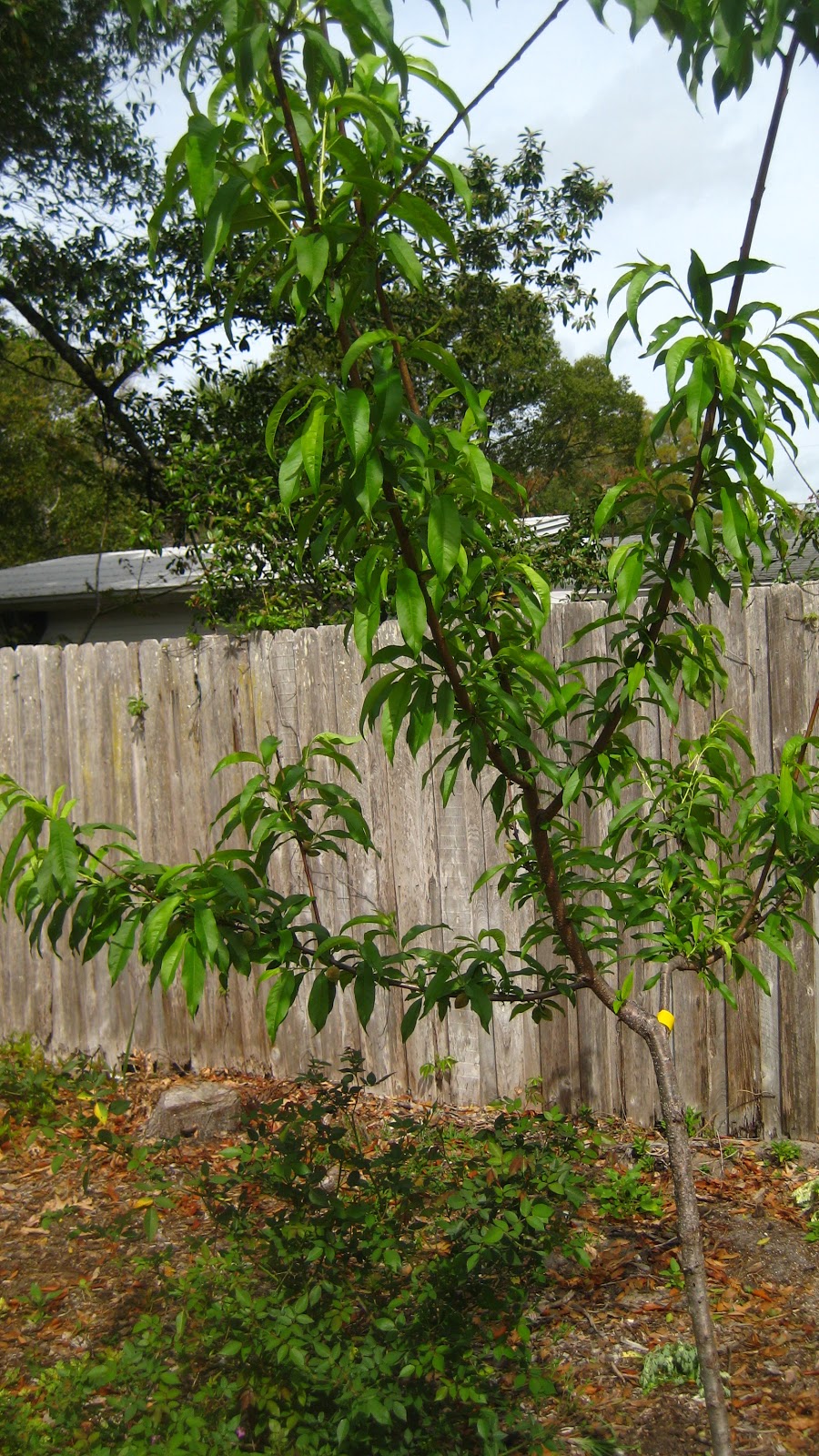
Earligrande peach. Way ahead of my FlordaPrince, as the name implies. Second year in the garden. I left approximately fifty fruit on the tree, and culled the rest. I'm always astonished how prolific and quick peaches are.

One of my plums. It went in the ground at the same time as the peach (above). Much slower growth rate, but it looks ready to bear (relatively) heavily this year, probably twenty-five fruit.

I nursed this Osteospermum through the summer, in a large pot. It's very large now (three feet in diameter) and loaded with this lovely blooms.

First squash should bloom in a couple of days. Slick-Pik from Johnny's.

A bit of my new, front-yard bed.
Subscribe to:
Posts (Atom)