"We Americans are not usually thought to be a submissive people, but of course we are. Why else would we allow our country to be destroyed? Why else would we be rewarding its destroyers? Why else would we all—by proxies we have given to greedy corporations and corrupt politicians—be participating in its destruction? Most of us are still too sane to piss in our own cistern, but we allow others to do so and we reward them for it. We reward them so well, in fact, that those who piss in our cistern are wealthier than the rest of us."
Thursday, June 28, 2007
Compromise, Hell! | Wendell Berry | Orion magazine
This is why I love Wendell Berry...


Monday, June 18, 2007
Garden hiatus...
I'm off for three weeks to The Great North. My garden will have to struggle on without me. Bill (aka castorp) will look in on it from time to time. Maybe he'll send me updates.
It's a good time to be gone from Central FLA.
The next blog post won't be until mid-July.
It's a good time to be gone from Central FLA.
The next blog post won't be until mid-July.
Sunday, June 17, 2007
Recommended Tomato

This cultivar was recommended on GardenWeb for Central FLA...
Tomato Growers Supply - huge selections of both hybrid tomato seeds and heirloom tomato seeds, hot chiles, sweet peppers, tomatillos and eggplants, plus garden supplies, garden books, and : "First Prize VFFNT Hybrid #3300 (30 seeds) $2.85
Exclusive release of Tomato Growers Supply Company. The kind of tomato home gardeners would love to grow for a county fair entry. Vigorous plants produce loads of delicious 10 to 12 oz. fruit, even when conditions are not ideal. This one was a winner in our trials for its high yields, good disease resistance, mid-early maturity, and great flavor. First fruit mature early and low on the plant, which continues to bear tomatoes over a long season. Indeterminate. 75 days"

Wednesday, June 13, 2007
Amaranth Grain

HARVEST
Basically, you must thrash it like mankind has always done until the invention of the thrashing machine. The three stages include let the heads dry out, knock the grain from the heads, and winnow the grain. Many of you live where local folks know far more than I about such techniques. For others, here is what we do with small quantities of seed (which must be kept separate from other varieties).
Cut the heads when the grain appears to be mature, and put them somewhere to dry. If left too long much of the grain may shatter (fall to the ground).
Grain easily shatters from the dried heads. Put a few heads in a burlap bag and beat it against the cement floor a few times to knock it loose, or strike the bags with a stick. Then place the grain in a 5-gallon bucket (many other containers would be suitable). You will notice that a lot of chaff comes along with the grain. This is where winnowing comes in.
Place an empty 5-gallon bucket in front of a fan and, cautiously at first, pour some grain and chaff into the empty bucket. A steady wind will accomplish the same thing as the fan, but a gusty wind will cause problems. The grain is denser and will fall closer to the fan than the chaff. Quickly one begins to get a feel for how far the buckets should be from the fan, and at what height to hold the one bucket in order for the grain to land in the empty bucket and the chaff to blow far enough to miss it. Pour the grain back and forth until it appears to be clean.
Final cleanup can be done by swirling and shaking the grain around gently. Remaining chaff will "float" to the top like ice in water, and can be removed by hand.
Tuesday, June 12, 2007
Pole Bean

RATTLESNAKE: 73 days. Especially good for sandysoil. Rattlesnake is a heavy producer in the hot, humid areas ofthe coastal Mid-Atlantic and South coastal areas where sandysoil prevails. Steamed snaps are sweet, rich, and full flavored. Stringless when pods are small to medium size. Vines are vigorous climbers which bear 7” round pods containing buff-coloredseeds splashed with brown. #13508 Pkt. $2.50These beans are growing up ten-gauge wire that I ran from stakes to the top of a twelve-foot piece of conduit. (I bent a coat hanger into a question-mark with a long tail, and fed the tail into the top of the conduit, giving me a loop anchored deep into the conduit.) Not only is it really beautiful and takes up next to no room in the garden, the setup makes harvesting easy. I've been harvesting a big handful of beans every day, and it looks ready to produce a lot more in the near term. I don't think they took 72 days. I'm pretty sure I planted them mid-May, so more like thirty days to begin bearing.
I'm going to let them fill out while I'm out of town and pick them for as canellini beans (which are nothing but green beans harvested for the bean, rather than the pod.)

Strawberries, peppers, tomatoes, beans, eggplants, figs...

Quite the booty today. I picked a handful of rattlesnake beans, some pimientos de padron and banana peppers, two deliciously ripe figs, a couple of strawberries (waaaaay out of season), an eggplant (one of many needing to be picked), a half-dozen tomatoes and more cherry tomatoes than I know what to do with.
Monday, June 11, 2007
Eggplant feast

We had some good friends over this weekend to help out with our eggplant overproduction problems... Both my 'Black Beauty' and 'Little Fingers' plants are producing loads of eggplants, which might be my favorite veg. I put together a sort of south-eastern Mediterranean feast, with Macedonian, Greek, and Turkish and Georgian foods. (Yes, I know Georgia isn't geographically linked to the Mediterranean, but culinarily and culturally there is a great deal of affinity, as Paula Wolfert argues in her book, The Cooking of the Eastern Mediterranean.) The premise was that the veg all be from the garden and that everything was to be served room temperature -- perfect for a hot Florida evening. I used my leaf celery for the first time. Delish. The plant seems to really appreciate a lot of shade, and doesn't grow very quickly. But the leaves have a very potent and clean celery flavor.
From Wolfert's Cooking of the Eastern Mediterranean, an excellent cookbook that explores a totally and unjustly disregarded region of the world.
EGGPLANTS STUFFED WITH WALNUTS
Not many vegetables taste better than eggplant tried in olive oil. The Georgians have a special frying method that eliminates greasiness without sacrificing taste. They split baby eggplants down the middle, then slip them, flesh side down, into a well-seasoned skillet (I use a non—stick skillet) with a small amount of oil. The skillet is covered so that the eggplants fry and steam at the same time.
Serves 6
- 12 baby eggplants or 6 Japanese eggplants (about 2 pounds total weight), halved lengthwise
- 1 ¾ teaspoons fine sea salt
FILLING:
- 2 cups (7 ounces) walnuts
- 1 clove garlic, peeled and finely chopped
- 1/2 teaspoon hot Hungarian paprika or more to taste ¼ teaspoon
- ground marigold petals or ground turmeric
- 1/3 cup chopped celery leaves
- 1/4 cup shredded basil leaves
- 1/4 cup chopped coriander leaves
- ¼ minced red onion
- 2 tablespoons mild vinegar, preferably rice wine vinegar
- ¼ cup pomegranate seeds, plus more for garnish
- 2 tablespoons olive oil
- Flat-leaf parsley for garnish
1. Sprinkle the cut sides of the eggplants with 1 teaspoon of the salt and place cut side down, on paper toweling. Weigh down with plates 20 minutes. Rinse the eggplants under running water and then gently squeeze out the moisture; pal dry with paper towels.
2. Meanwhile, in a processor, combine the walnuts with the garlic, paprika. marigold petals, and the remaining teaspoon of the salt. Puree until an oily paste forms. Add cup water and process to blend. Transfer the paste to a medium bowl and stir in the celery, basil, coriander, onion, and vinegar. Fold in he pomegranate seeds. Cover and set aside.
3. In a the non—stick skillet, heat the olive oil over moderately low heat. Add all the eggplants cut side down. Cover tightly and cook until the flesh is golden brown and the eggplants are very tender, about 15 minutes. Transfer to paper towels to drain. (If the skillet is not large enough, you will have to cook the eggplants in batches.
4. With your fingers, press open the middle of the cut side of each eggplant. Mound the walnut ffilling into each eggplant half and serve warm or at room temperature. Gardnish with parsley and pomegranate seeds.
Thursday, June 07, 2007
Queensland Lettuce
VEGETABLES AND SMALL FRUITS IN THE TROPICS: "Queensland. Pat and Connie Lahr gave us a packet of seed for this lettuce after a visit to Australia. Pat believes it is grown primarily by an association of organic market gardeners. As far as he knows seed is not sold commercially. It is a big leaf lettuce that appears to be exceptionally resistant to bolting. Leaves are large, somewhat resembling a cos-type lettuce, with an attractive yellowish hue. In Australia they say it produces 8 weeks in summer, up to 14 weeks in winter and that it is best to use lower leaves.
My main interest is their apparent resistance to heat. We have not done carefully controlled experiments, but 'Queensland' appears to outlast most of our lettuce varieties when the warm season arrives. Each time we grow it I wonder, 'Is this ever going to bolt so we can save seed?' (A key to preventing bolting is to make sure the plants are never water stressed. It might well be that they would bolt quickly if we did not have irrigation.) ECHO produces a small quantity of seed for our network. Be sure to save your own seed if it does well.
Several people wrote concerning their results with 'Queensland' lettuce. Ken Turner in the Philippines says 'it was the best of 10 leaf lettuces tested, for ease of growing, durability and taste. I'm impressed. If leaf lettuce could just become an alternative here to"
My main interest is their apparent resistance to heat. We have not done carefully controlled experiments, but 'Queensland' appears to outlast most of our lettuce varieties when the warm season arrives. Each time we grow it I wonder, 'Is this ever going to bolt so we can save seed?' (A key to preventing bolting is to make sure the plants are never water stressed. It might well be that they would bolt quickly if we did not have irrigation.) ECHO produces a small quantity of seed for our network. Be sure to save your own seed if it does well.
Several people wrote concerning their results with 'Queensland' lettuce. Ken Turner in the Philippines says 'it was the best of 10 leaf lettuces tested, for ease of growing, durability and taste. I'm impressed. If leaf lettuce could just become an alternative here to"
Friday, June 01, 2007
Neem
Neem: Mode of Action: "Neem: Mode of Action of Compounds Present in Extracts and Formulations of Azadirachta indica Seeds and Their Efficacy to Pests of Ornamental Plants and to Non-Target Species"
Tuesday, May 29, 2007
What to do with a mess of peppers...

From Julie Sahni's magnificent Classic Indian Vegetarian and Grain Cooking...
HYDERABAD HOT GREEN CHILI PEPPERS BRAISED IN ALMOND-CREAM SAUCE (Mirch ka Salan) + For some Indians flavoring food with hot chilies is not enough. They want to eat the chilies in their own right. So here is a recipe from Hyderabad of chili peppers braised just as you would any vegetable, in an almond-cream sauce. In the recipe I recommend Anaheim chilies, as I find the hot green chilies too strong. But for those with a fiery palate, poblano peppers probably would be more suitable here. FOR 6—8 PERSONS
- 7 tablespoons light vegetable oil
- 1 cup minced onion
- 3—inch stick cinnamon
- 1 ½ teaspoons minced garlic
- 1 tablespoon shredded fresh ginger
- 2 tablespoons ground almonds
- 1 tablespoon ground coriander
- ½ cup water
- 1 teaspoon ground cumin
- ½ teaspoon ground cardamom
- ¼—½ teaspoon cayenne pepper
- 1 cup coconut milk, plain yogurt, light cream, or a combination of all these
- 1 pound mildly hot fresh green chilies (such as Anaheim, preferably small ones), slit
- 2 medium-size tomatoes, cut into 1-inch-thick wedges
- 2 tablespoons finely chopped fresh coriander
- 3/4 teaspoon coarse salt, or to taste
- Heavy cream or milk
1. Measure out the spices and place them right next to the stove in separate piles. Heat 4 tablespoons of the oil in a heavy skillet until hot and add the onion. Over medium-high heat fry the onion until light brown, stirring constantly to prevent burning (about 10 minutes).
2. Add the cinnamon, garlic, ginger, and almonds, and continue frying until the seasonings look a little shriveled and the almonds begin to darken (3—4 minutes). Add the coriander, cumin, and cayenne, and let sizzle for 1 5 seconds; then add the coconut milk and bring to a boil. Lower the heat and cook, covered, for 10 minutes. Uncover and continue cooking until the mixture looks like a thick pulp and the oil begins to separate from the gravy. Add the ½ cup water and cook for an additional 3 to 5 minutes or until the water has blended in and the sauce develops a nice thick consistency. Turn off the heat. With a spatula transfer all the sauce to a howl.
3. Add the remaining 3 tablespoons of oil to the same pan. Increase the heat to medium-high and add the chili peppers. Sauté, turning them, for 3 to 5 minutes or until they are well coated with oil, look glazed, and begin to steam. Add the tomatoes, increase the heat to high, and continue cooking, turning and tossing, for an additional 1 or 2 minutes.
4. Add the reserved sauce and mix well. Lower heat and cook, cove red, until the peppers look wilted (about 10 minutes). Do not overcook or they will become too limp and soft. Check and stir a few times to make sure the sauce is not sticking or burning. Stir in the coriander and salt. Turn off heat. Serve warm. If desired, fold in a few tablespoons of cream or milk to mellow and velvetize the sauce.


Black Swallowtail Caterpillar
I planted a bunch of bronze fennel last fall, aiming to attract Black Swallowtail caterpillars. They decidedly prefer my garden's Florence Fennel, which is about to bloom. I wonder if I'll be able to harvest fennel seeds? That's one of my favorite spices...


Sunday, May 27, 2007
Tomatoes
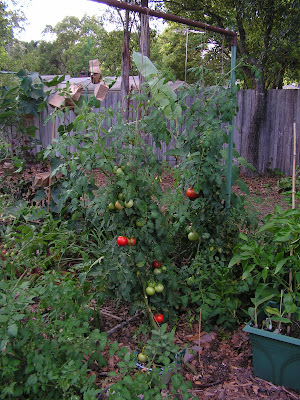
(tomatoes on the trellis -- matt's wild on the left, tiffany in the middle, better boy in the background
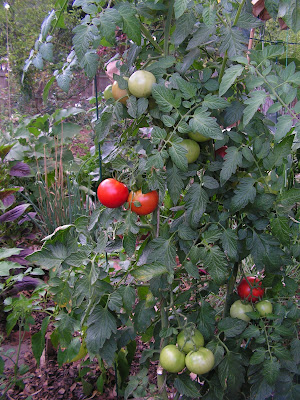
(tiffany, with thirty-eight walnut-sized or larger tomatoes and another dozen or so smaller. i've already harvested no fewer than a dozen. it's a VFNT hybrid, so no disease problems. pretty good flavor, great texture, good keeping. nice to have smaller tomatoes (3-4 oz). they look exactly like those "tomatoes on the vine" from the grocery store, growing in clusters of 4-5 fruits. from TGS.)
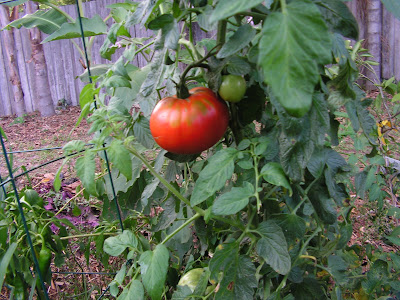
better boy. i've harvested several tomatoes that weighed in at more than a pound. delish. but in the end, the tiffany produces more tomatoes and the size is better suited for eating.
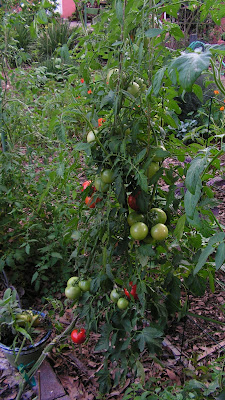
another shot of tiffany, from the other side, so you can see how many tomatoes are on one vine. the whole bush must weigh 30#, and i've had to add a bunch of strings to keep it up. they didn't break during the heavy winds this week.
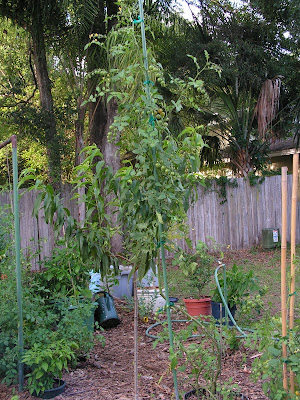
i don't know if you can see this: but in the middle of the photo, a sun gold, growing in a large pot, that has hit the 9 foot limit of the conduit i'm using as a pole. i've decided to pull all the leaves from the bottom 1/3 of the plant and make it into a tree. my garden is a mess.
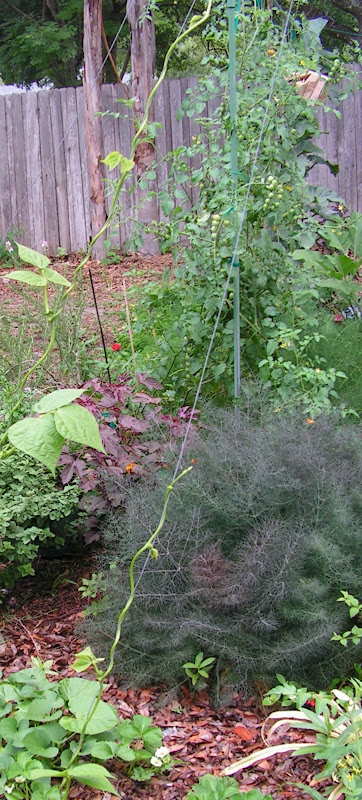
'yellow currant' (TGS). not a very good pic, but what a tomato! it's already at 10', much better behaved than matt's (it grows upright and the stems are self-supporting with a very little bit of help), more prolific than sungold, and the tomatoes are pretty good. if you look carefully, you can see the scads of tomatoes that grow in clusters of about 20 1/2" tomatoes.
anyway -- the in-ground tomatoes are all planted using the posthole method (thanks, delta charlie!), with one slight improvement: i dig out all the crappy sand in a narrow (maybe 18" diameter) hole, enough to fill a 5-gallon bucket. the sand gets dumped in a low spot in my yard. i use three or four paper grocery sacks, stacked together to form a very thick, stiff bag, to line the hole: i fold the top edge down a few times, enough to form an even stiffer cuff around the top of the bag, so the bag remains open and is about 2' tall. then, i stuff the bag into the hole i've dug, leaving the cuff a bit above the surface. i fill the hole with straight-up compost from my kitchen-scrap heap. i usually add a handful of water-retention crystals (i nursery friend gave me a ton of them for free), and then i test the ph and adjust with sulfur. (for whatever reason, my compost is a bit sweeter than tomatoes like it.) (oh, and without complicating things too much here, the tiffany was not planted using the paper bag method, but instead using two large nursery pots with their bottoms cut out and then tied together with twine through the drainage holes, forming a cylinder about 2' long. it was way too much work, very awkward to install, and led me to the paperbag method.)
the cuff lets me do two things -- i fill it with mulch and it allows me to water more easily (just fill the cuff with water and let it seep in). it also keeps the bad soil out.
anyway, the paper bag just makes the posthole method a bit easier, since you don't have to worry about the sand collapsing back into the hole. it also keeps the nematodes out, though for how long, i don't know. every week or so, i add a couple handfuls of compost to the top of the bag to fertilize the tomatoes and keep the soil level constant.
i haven't dug one of the tomatoes out yet, but presumably the roots of the tomatoes will eventually make it through the paper bag. the plants seem pretty low in their watering needs.
oh, the trellises i've used are made from leftover chainlink fence posts. it was a lot of work, but is VERY sturdy (i did a pullup on it, and i weigh about 200 pounds!). the lighter one in the front of my bed is made from conduit -- $15 total cost in parts and it took me less than 15 minutes to install, since the conduit is stiff and narrow enough to push by hand through the sand to a depth of five feet. the elbows were more expensive than the 10' conduit lengths.
ok, i've goofed off enough here. now's time to goof off in the garden!
an update: i take back what i said about the paper-bag method's superiority over the nursery pots. when i cleaned up the garden at the end of the season, the bags had completely disintegrated, and much of the organic material in the hole had dissolved into the surrounding sands. but the nursery pots were still full of humus. so, though they are more difficult to install, i will definitely convert all my tomato holes into nursery-pot holes.
Friday, May 25, 2007
Garden update...

An ornamental banana coming into bloom...

A pomegranate in bloom...

'Little Fingers' from TSG. Cool, no?

The pickleworms have met their match...
Thursday, May 24, 2007
Panzanella
Another from-the-garden recipe. I'm totally overwhelmed by the number of cherry & currant tomatoes that are ripening now.
My wife is a first-rate baker. She uses the levain method: no yeast, just naturally-occurring bacilli and yeasts. Florida's got some of those. She bakes at least three times a week -- huge, two-pound loaves. We eat it with every meal. Her bread is dense, pocketed with fissures and holes, wheaty, slightly acidic without being sour. The crust is thick, crispy, and golden. We've lived for long periods in Europe, in the heartland of good bread, and hers would stand toe-to-toe with any bread I've ever eaten.
Here's what I did with it...
Panzanella
This will serve two for a main dish or four as a salad. The point is to create a gustatory party of colors, textures, flavors and smells.
My wife is a first-rate baker. She uses the levain method: no yeast, just naturally-occurring bacilli and yeasts. Florida's got some of those. She bakes at least three times a week -- huge, two-pound loaves. We eat it with every meal. Her bread is dense, pocketed with fissures and holes, wheaty, slightly acidic without being sour. The crust is thick, crispy, and golden. We've lived for long periods in Europe, in the heartland of good bread, and hers would stand toe-to-toe with any bread I've ever eaten.
Here's what I did with it...
Panzanella
This will serve two for a main dish or four as a salad. The point is to create a gustatory party of colors, textures, flavors and smells.
- a few handfuls of cherry/currant tomatoes, or a couple of large tomatoes. I like to use a mix of cherries (Sun Gold, Yellow Currant, Matt's Wild). If you're using small tomatoes, just squeeze them by the handful -- careful of the mess. Or dice the large tomatoes medium.
- lots of scallions, preferably red ones (for the color). tops and bottoms chopped roughly
- tomato-friendly herbs: mint, basil, oregano and parsley. A few handfuls of each, though let the parsley predominate.
- a few cucumbers or sweet peppers, chopped roughly (a little something crunchy)
- 1/2 c. flavorful olive oil (bring out the good stuff)
- 3-4 tbsp. of red wine vinegar
- salt (I like flake sea salt) and pepper (coarsely ground)
- 1 pound peasant bread, ideally a little stale, torn into 1 inch chunks
Wednesday, May 23, 2007
And the winner is...
I wanted to quickly note the State of Tomatoes in my garden. On January 6, I planted three full-sized tomatoes:
-Tiffany (a VNFT hybrid from TGS)
-Better Boy (a VFN hybrid)
-Matina (from TGS)
Tiffany produced early (end of April) and prolifically. Smallish (4 oz), perfectly round, smooth (no shoulders). OK flavor, very good texture. Fair number of seeds. They look just like those "tomatoes on the vine" you get from the supermarket. Somewhat subjectively, I'd say these hang around on the vine for a long time while ripe without suffering for the delay. Good yield, and it's nice to have smallish tomatoes.
Matina has been very disappointing. Nice tomatoes, but they actually ripened later than Tiffany (I bought them because they're supposed to be very early), and the yield has been low.
Better Boy produced a large crop, a week or so later than Tiffany. Fewer in number than Tiffany, though the yield seems roughly the same in weight. Beautiful, flavorful, dense flesh, low in seeds. I weighed one today at exactly 16 oz. It deserves all the praise it gets. I'd like to sniff and say "well, it doesn't have the flavor of a Brandywine..." or some such, but let's face it: Perfectly ripe, homegrown tomatoes all taste really really good. Subtle differences in flavor shouldn't overshadow more important criteria. It makes sense to me to choose varietals that are prolific and disease resistant. Beyond that lies only snobbery parading as discernment.
-Tiffany (a VNFT hybrid from TGS)
-Better Boy (a VFN hybrid)
-Matina (from TGS)
Tiffany produced early (end of April) and prolifically. Smallish (4 oz), perfectly round, smooth (no shoulders). OK flavor, very good texture. Fair number of seeds. They look just like those "tomatoes on the vine" you get from the supermarket. Somewhat subjectively, I'd say these hang around on the vine for a long time while ripe without suffering for the delay. Good yield, and it's nice to have smallish tomatoes.
Matina has been very disappointing. Nice tomatoes, but they actually ripened later than Tiffany (I bought them because they're supposed to be very early), and the yield has been low.
Better Boy produced a large crop, a week or so later than Tiffany. Fewer in number than Tiffany, though the yield seems roughly the same in weight. Beautiful, flavorful, dense flesh, low in seeds. I weighed one today at exactly 16 oz. It deserves all the praise it gets. I'd like to sniff and say "well, it doesn't have the flavor of a Brandywine..." or some such, but let's face it: Perfectly ripe, homegrown tomatoes all taste really really good. Subtle differences in flavor shouldn't overshadow more important criteria. It makes sense to me to choose varietals that are prolific and disease resistant. Beyond that lies only snobbery parading as discernment.
Monday, May 21, 2007


Deland, Florida (32724) Conditions & Forecast : Weather Underground
Deland, Florida (32724) Conditions & Forecast : Weather Underground: "Statement as of 5:05 PM EDT on May 20, 2007
... Record low temperature equaled at Daytona Beach...
The low temperature this morning at Daytona Beach of 54 degrees...
ties the record low for this date previously set in 1984."
... Record low temperature equaled at Daytona Beach...
The low temperature this morning at Daytona Beach of 54 degrees...
ties the record low for this date previously set in 1984."
Jene's Tropical Fruit
Jene's Tropical Fruit: "Jene’s Tropicals offers a diverse collection of Florida tropical plants and other tropical fruit trees from around the world. All of these Florida tropical plants are extremely healthy and ready to be shipped to many places within the USA. Jene’s Tropicals take great pleasure in sharing amazing Florida tropical plants and tropical fruit trees with you!"
Berries:
| Blackberries | Blueberries | Mulberries | Raspberries |
Sunday, May 20, 2007
really really amazing weather
All winter I complained about how screwy the weather was (recall the tornadoes that affected the area twice this winter). Well, today's weather was simply unreal: High 70s, with a dewpoint in the 40s: Another backdoor front passed through last night (I think), pulling down nice air. This kind of weather typifies our February and March weather. By this time of the year, we're usually sweating it out in the upper 80s with dewpoints of 74. Not quite unbearable, but not comfortable, either. We hardly used the AC since, well, December. It's dry and the sun is hot and the day is long. With an early morning, daily watering, my plants are going wild.
 Another backdoor front passed through last night (I think), pulling down nice air. This kind of weather typifies our February and March weather. By this time of the year, we're usually sweating it out in the upper 80s with dewpoints of 74. Not quite unbearable, but not comfortable, either. We hardly used the AC since, well, December. It's dry and the sun is hot and the day is long. With an early morning, daily watering, my plants are going wild.
Subscribe to:
Posts (Atom)